In this article
- Five Questions That Decide Whether to Stay or Move Out
- How to Live at Home During a Remodel Safely
- Lead Paint and Asbestos in Older Homes
- When Moving Out Is the Right Call
- What to Require From Your Contractor
- Kids, Pets, Noise and Belongings
- Budget for the Disruption
- How Mr Build Plans Remodels Around Your Household
Yes, you can often live at home during a remodel when the work is confined to one area, you keep a working bathroom and some way to cook, and nobody in the household has a health condition that makes dust risky. Staying gets impractical when the project takes out whole-house systems, disturbs lead paint or asbestos, or leaves every bathroom and the kitchen unusable at once.
Most of the decision comes down to five questions, good containment and a contract that spells out what the crew will do every day. This guide covers all three, plus when moving out is the better call and how to handle kids, pets, noise and belongings if you stay.
Five Questions That Decide Whether to Stay or Move Out
Answer these before you sign, because the answers change the schedule, the containment plan and sometimes the price.
- How much of the house does the work touch? One room or wing is very different from a whole-house remodel.
- Will water, power, gas or heating and cooling be shut off, and for how long? Hours are manageable; days without water are not.
- Who lives in the house? Infants, young children, a pregnancy, or anyone with asthma or another respiratory condition raises the bar.
- Does the work disturb old paint, flooring, ceilings or insulation? In older homes that can bring lead or asbestos rules into play.
- Can the work area be fully sealed off with a separate way in for the crew? If the crew has to walk through your living room all day, staying is much harder.
A "no" on utilities or health often outweighs a "yes" on everything else. Ask your contractor to answer each question in writing for your project, with the specific days each utility will be off.
How to Live at Home During a Remodel Safely
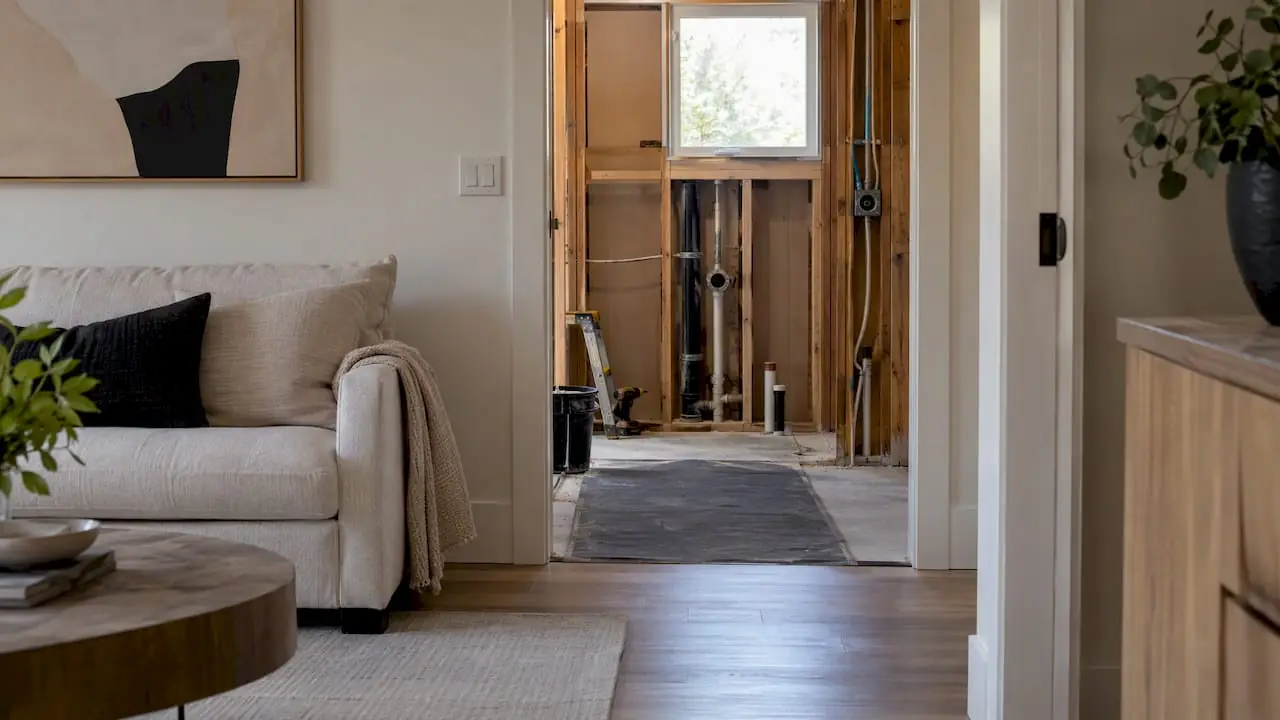
Staying home works when containment is part of the contract, not something the crew improvises.
Containment and air
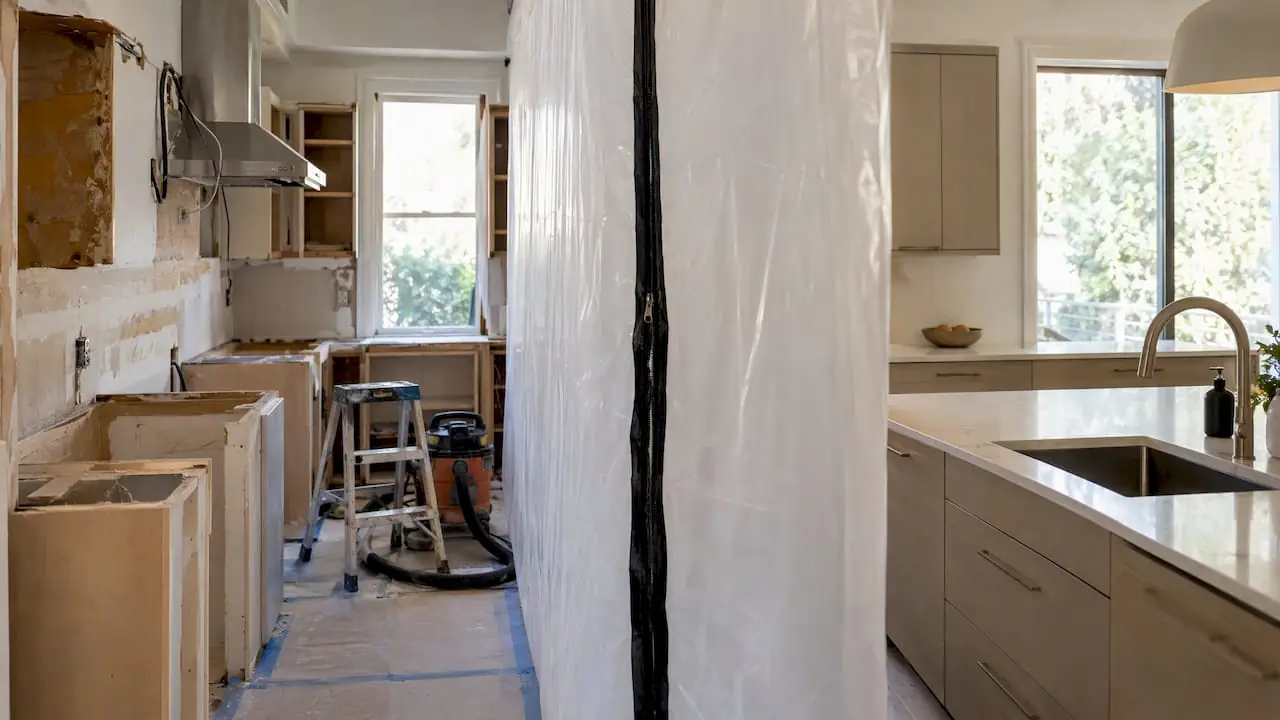
- Floor-to-ceiling barriers with taped seams and a zipper or flap door, not loose plastic hung from a doorway.
- A separate crew entrance, ideally an exterior door or window opening, so workers and debris do not pass through living space.
- Negative air where practical: a fan with HEPA filtration exhausting from the work area to the outside, so air flows into the work zone instead of out of it. Federal occupational health guidance for renovations in occupied buildings recommends this approach.
- HVAC protection: supply and return registers inside the work zone sealed, and the system filter checked and changed often. Running central air while drywall is being sanded spreads dust through the whole house.
- Daily cleanup: HEPA vacuuming and wet wiping in and around the work zone at the end of every day.
A refuge room
Pick a bedroom or den on the far side of the house from the work, keep it off-limits to the crew and run a portable HEPA air purifier there. That is where kids nap, people work from home and pets stay during the loudest days.
Temporary kitchen and bathroom
For a kitchen remodel, set up a folding table, microwave, small fridge, electric burner and a dish tub near a laundry or bathroom sink. For a bathroom remodel, make sure another bathroom stays usable. If it is your only full bath, ask about phasing so the toilet stays connected as long as possible, or plan a short stay elsewhere. Our home remodel timeline shows when each room is typically out of service.
Lead Paint and Asbestos in Older Homes
If your home was built before 1978 and the work disturbs painted surfaces, the federal EPA Renovation, Repair and Painting rule applies once the work goes beyond small minor-repair amounts (roughly 6 square feet per room inside). That means:
- The firm must be EPA lead-safe certified and the work directed by a certified renovator.
- You must receive the EPA Renovate Right pamphlet before work starts.
- The work area must be contained, and cleaning must be verified before containment comes down.
Lead dust is a serious hazard for young children and pregnant women, so many families with small kids move out during demolition and sanding in a pre-1978 home even with good containment.
Asbestos can be found in older popcorn ceilings, vinyl flooring, drywall joint compound, pipe insulation and some siding. If the materials are suspect, have them tested before demolition. Removal is done by a licensed abatement contractor under its own rules, and you should plan to be out of the house while it happens.
When Moving Out Is the Right Call
Some projects make staying impractical no matter how good the containment is:
- Whole-house rewiring, repiping or HVAC replacement
- Lead or asbestos abatement
- Every bathroom and the kitchen out of service at the same time
- Major structural work, such as removing bearing walls or foundation work
- Floor refinishing with strong fumes across main living areas
- Whole-home remodels and demolition-and-rebuild projects
A middle path is common: stay home for most of the project and leave for the worst stretch, such as demolition week, a utility shutoff or floor finishing. Options for temporary housing:
| Option | Typical length | Works best for |
|---|---|---|
| Extended-stay hotel | Days to weeks | Small households who want a kitchenette |
| Furnished short-term rental | Weeks to months | Families who need space and privacy |
| Family or friends | Days to a couple of weeks | Short, high-disruption phases |
| RV on the property | Weeks to months | Staying close, if space and local rules allow |
| Short-term lease | Months | Whole-home remodels and rebuilds |
Before you leave, agree on how the crew gets in, who has keys or codes, how often you will get updates and photos, and the cleaning standard the house must meet before you move back.
What to Require From Your Contractor
The best way to weigh staying against moving out is to ask for two schedules for the same scope: one with you living there and one with the house vacant. Occupied work can take longer because crews set up and take down containment, clean more and sometimes work in phases. Seeing both numbers makes the trade-off concrete. Our post on phased remodeling explains how phasing affects time and cost.
If you decide to stay, the contract or scope should spell out:
- Containment type and location, including the crew entrance and path
- Air filtration and who maintains it
- Daily cleanup standards
- Advance notice for every utility shutoff, with dates and expected duration
- Working hours, within your city's construction noise rules
- Lead-safe certification, the Renovate Right pamphlet and cleaning verification, if the house was built before 1978
- One point of contact and a regular update schedule
Kids, Pets, Noise and Belongings
Children and pets
Keep children and pets out of the work zone entirely, with a baby gate or closed door in addition to the containment wall. Ask the crew to lock up tools and secure the site every evening, since nails, cords and open floor penetrations are common hazards. If your dog tends to bolt, pick one door for crew and deliveries and tell everyone. Noise-sensitive pets often do better boarded or with family during demolition.
Noise
Noise is often the most constant disruption once dust is under control. Ask for a written weekly schedule showing loud days, such as demolition, framing and tile cutting, so you can plan calls, naps and work around them. On the loudest days, working from a library or coworking space is often easier than trying to work through it.
Furniture and belongings
Clear the work zone completely and cover furniture in nearby rooms, because fine dust travels further than people expect. For a single room, a garage or spare room may be enough. For larger projects, a portable storage container in the driveway or an off-site unit works, depending on how much driveway space the crew needs for materials and a dumpster.
Budget for the Disruption
Living at home has its own costs: extra meals out during kitchen work, a few nights in a hotel, storage, possibly boarding pets. Older homes can also reveal water damage, outdated wiring or framing problems once walls open, and fixing them can extend the schedule enough to change whether staying still makes sense. Keep a contingency in your budget and get every change in writing, with its effect on the schedule, before the work proceeds.
It also helps to price the alternative honestly. Weigh the cost of a furnished rental against restaurant meals, lost work time and any extra weeks an occupied schedule adds, since a vacant house often lets the crew work faster. Put the two schedules side by side with the housing cost before you decide.
How Mr Build Plans Remodels Around Your Household
Mr Build plans occupied work from the first consultation. We talk through who lives in the house, which rooms must stay usable and which phases might be easier to spend elsewhere. Containment, utility shutoffs and the crew's path go into the written scope, and a dedicated project manager keeps you updated as the work moves through the house.
Whether it is a kitchen, a bathroom or a complete home remodel, we can show you how staying home or moving out would play out on your project. See our work as a home remodeling company in Brentwood and across Los Angeles and Orange County, then book a free on-site consultation.
Sources and further reading
- EPA Renovate Right epa.gov
- cdc.gov: 2020 110 cdc.gov
- Extended Stay America’s guidance extendedstayamerica.com
- pipercolearchitects.net: remodel while living at home seattle pipercolearchitects.net