


If you are planning an accessory dwelling unit (ADU) in West Hollywood, the short answer on parking is good news: the City of West Hollywood does not require off-street parking for ADUs, whether the unit is newly built or created by converting existing space. If you convert a garage or carport, the city does not make you replace the spaces you lose. What remains is a set of practical questions about your own lot, your street and the people who will live there. This guide covers those questions.
TL;DR
- West Hollywood requires no off-street parking for an ADU, new construction or conversion.
- Converting a garage or carport does not trigger a replacement-parking requirement.
- No requirement does not mean no need: your street, your tenants’ cars and your own vehicles still count in the design.
- Street parking in West Hollywood runs on permits, preferential districts and posted enforcement hours, so check the rules for your block before you plan.
- Setbacks and site layout, not parking, are usually what shape an ADU on a West Hollywood lot.
Table of Contents
- What West Hollywood requires for ADU parking
- Why “no requirement” is not the same as “no plan”
- How street parking works for West Hollywood residents
- Garage conversion: the most common parking question
- Setbacks and layout shape your site more than parking does
- Do ADU tenants get street parking?
- Construction-phase parking: the part owners forget
- Our perspective: design the parking decision, don’t inherit it
- A step-by-step way to settle your parking plan
- Planning your West Hollywood ADU with us
- FAQ
- Sources
What West Hollywood requires for ADU parking
The city’s ADU guidance is direct. Property owners are not required to provide off-street parking for an ADU, and when a garage, carport or covered parking structure is demolished or converted to create an ADU, those spaces do not have to be replaced. That applies to the main routes homeowners take:
- Detached new ADU in a back yard: no parking space is required for it.
- Garage conversion: the garage becomes living space, and you are not asked to build a replacement space elsewhere.
- Attached ADU or addition: the same no-parking-minimum approach applies to the unit.
This is part of a broader shift. West Hollywood has been updating its parking rules to meet new state requirements and removing citywide parking minimums. The city frames the change as support for housing affordability and walkability, leaving property owners to decide how much parking to provide based on what the property actually needs.
The city’s code also carries a general caveat that off-street parking standards apply to the extent permitted by state law. For ADUs, state law is the reason the answer is so favorable, and the city’s ADU ordinance is what applies on your project. Rules in this area have been amended repeatedly, so confirm the current text with the Community Development Department before you finalize drawings.
Why “no requirement” is not the same as “no plan”
A city can waive a requirement without making cars disappear. Before you decide what to do with your garage or driveway, think through four things.
Your own vehicles
If you park in a garage today and convert it, those cars move to the driveway, to the street or to a permit. Count the vehicles in your household honestly, including any that come with adult children or a live-in relative.
Your ADU occupants
An ADU may house a family member, a long-term tenant or a caregiver. Each of them may own a car. Whether that is one more vehicle or none depends on who you expect to live there and how they get around.
Your block
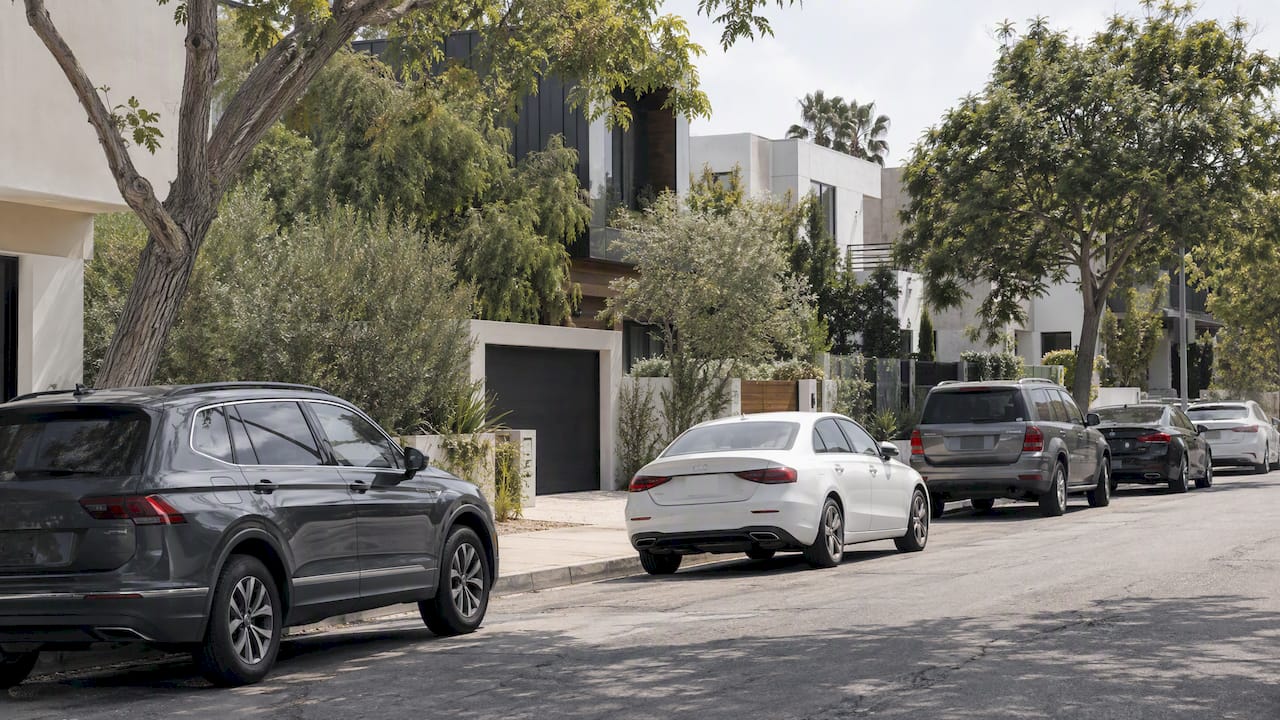
Many West Hollywood streets are in preferential parking districts. Parking supply on your block, and who is allowed to use it, affects daily life far more than the zoning code does.
Your resale and rental position
A unit with usable parking is easier to live in. A unit with none can still be attractive near transit and walkable neighborhoods, but it is a trade-off you should make on purpose.
How street parking works for West Hollywood residents
If your plan depends on the street, learn how the city manages it. The city’s stated purposes for enforcement include protecting residential streets so residents can find parking near their homes, supporting local businesses and keeping traffic moving.
The city’s parking permit page explains the main options:
- Annual resident permits, limited to four per address. Each permit is tied to a license plate.
- Documentation: proof of residence, a valid photo ID and a current California vehicle registration.
- Preferential parking districts: your residency documents must match the service address in the district.
- Overnight resident parking permit for residents who need to park overnight.
- Guest and visitor permits for people who do not live at the address.
Two details matter for ADU owners. First, the four-permits-per-address limit is a ceiling for the whole address, so a main house plus an ADU share it. Second, eligibility rules tie permits to residency documentation and California registration. Before you promise a tenant street parking, ask the city’s parking services how permits are handled for a second dwelling on your parcel. We would not assume an answer either way.
Meters follow posted hours that differ by zone. As a general rule of thumb for Los Angeles-area streets, yellow curbs and meters have time windows that lapse in the evening and on Sundays, but residential permit restrictions can apply independently of meter rules. The sign on your block is what counts.
Garage conversion: the most common parking question
Most West Hollywood homeowners who ask about ADU parking are really asking about a garage. The garage is already built, it has a slab and walls, and the city does not ask you to replace it. That makes conversion an appealing route.
Things to weigh before you convert:
- Where will the cars go? If your driveway fits one or two vehicles, you may be comfortable. If not, price the daily inconvenience, not just the build.
- What condition is the garage in? Slab, framing, electrical, insulation and ceiling height all affect how much work the conversion needs. Our guide, Should You Convert Your Garage Into an ADU?, walks through what we check first.
- Do you want to keep covered parking and add a unit? A detached ADU in the back yard, or a unit built over a garage, keeps your covered space. It is a different build with different site constraints.
- Do you want EV charging? If you drive an electric vehicle, charging at home matters more once your garage is gone. Planning a carport or outdoor charging location early is easier than retrofitting. The design lessons in this guide to solar carports and EV planning for property owners are a useful read if you are weighing a covered replacement for the space you convert.
Neither choice is wrong. A converted garage can be a fast, well-integrated path to an extra unit. A detached ADU can preserve parking and give the new unit more privacy. The better choice depends on your lot and how you live.
Setbacks and layout shape your site more than parking does
On many West Hollywood lots, the limiting factors are not parking but where a unit can physically sit. California law allows four-foot side and rear setbacks for qualifying ADUs, and the city’s own ordinance for ADUs that fall under that subsection requires conformity to four-foot side and rear setbacks. Local rules can add conditions on top of that, such as separation from the main house. We cover that catch in detail in West Hollywood’s 4 feet of setback and what comes with it.
Put together, your layout questions look like this:
| Question | Why it matters for parking |
|---|---|
| Where is the existing garage or carport? | Determines whether conversion is the natural choice |
| How wide is the driveway and curb cut? | Sets how many cars can stay on site |
| How much back yard remains after setbacks? | Decides whether a detached ADU fits and what is left over |
| Are there trees, utilities or easements? | Can rule out parking or building areas |
| Is there alley or rear access? | Can offer a place for a car without using street frontage |
A site walk-through with a builder answers most of these in one visit.
Do ADU tenants get street parking?
This is the question that often catches owners off guard. Los Angeles-area coverage has described tenants losing parking when spaces are converted to ADUs under recent state law, and the broader concern is that residents may have no legal place to park near home unless they find spaces in non-permit areas farther away. In West Hollywood, permits are linked to residency documentation and to preferential districts, so the practical answer depends on your block and on the city’s current permit process.
If you rent out your existing garage to a tenant today, converting it ends that arrangement. Think about that conversation early, and review your lease obligations with an attorney if you have existing tenants.
For your future ADU occupant, your options typically are:
- A driveway space, if your lot allows it.
- A permit for a preferential parking district, if the city confirms eligibility.
- A nearby garage or lot. West Hollywood publishes a parking facility directory of public structures, with hours that can change, such as new midnight closing times at some garages announced for 2026.
- Living car-light: walking, biking, transit and rideshare, which many West Hollywood residents already do.
Construction-phase parking: the part owners forget
Parking affects your project before the unit exists. Crews, deliveries, dumpsters and material staging all need space, and in a dense city that means planning around posted restrictions. A few practical points:
- Ask your contractor how they handle worker parking and what they plan to do on a street with permit restrictions.
- Tell your neighbors before work starts. Courtesy goes a long way on a shared block.
- Keep driveway access in mind if you have to keep a car at home during demolition.
- Review rules about street use, such as for dumpsters, with the city before work starts, because we would not guess at what a given block requires.
Street rules are local and can change. The enforcement page and the signs on your block are the authority.
Our perspective: design the parking decision, don’t inherit it
We build ADUs, additions and remodels in Los Angeles, and parking questions come up on almost every ADU consultation. Our view is simple: the city’s decision to remove parking minimums gives you a choice, and a choice deserves a plan.
The best projects we see start with how the household will actually live. Who will use the unit? How do they get to work? Where does your car sleep at night? Once that is answered, the building choices follow. Sometimes the right call is to convert the garage and use the driveway. Sometimes it is to build detached and keep the garage. Sometimes it is to remove a driveway slab to gain yard space.
We also believe in checking local rules with the city rather than relying on assumptions. Our work includes expertise in local permitting, and we coordinate design, permitting and construction so that parking, setbacks and layout are settled together rather than discovered one at a time. If you want background on how approval works, our overview of getting an ADU permit in Los Angeles covers the process.
We would rather tell you early that a site is tight than let that surface after drawings are done.
— David S.
A step-by-step way to settle your parking plan
- Write down your vehicles. Include current cars, likely future ones and any EV charging needs.
- Identify who will live in the ADU. Family, tenant or caregiver, and how many cars they are likely to have.
- Read the signs on your block. Note permit districts, meter hours and any posted restrictions, and read the city’s parking enforcement page.
- Measure the lot. Driveway width, garage size, rear access and setbacks.
- Decide between conversion and detached. Compare keeping the garage against using its footprint.
- Confirm permit eligibility. Ask city parking services how permits work for a second unit on your address.
- Fold the decision into design. Parking, entry paths, utilities and the unit layout should be drawn together.
Planning your West Hollywood ADU with us
If you are ready to turn a garage, back yard or side lot into a livable unit, our team can walk the property with you, review setbacks and parking options and manage design, permitting and construction under one plan. See our ADU builder page for West Hollywood or our overview of ADU and addition services, then schedule a consultation to talk through your lot.
The city also runs a Pre-Approved ADU Plan Program intended to reduce the time spent on architectural and engineering design. Ask us whether it suits your lot or whether a custom design serves you better.
For comparison with neighboring jurisdictions, our Beverly Hills ADU rules guide shows how requirements can differ one city over. More reading is in our ADU and additions archive.
FAQ
Does West Hollywood require parking for an ADU?
No. The city does not require off-street parking for ADUs, whether the unit is new construction or a conversion. Check the current ordinance with the city before finalizing plans, since the rules have been amended recently.
If I convert my garage, do I have to replace the parking?
No. West Hollywood’s ADU guidance says spaces lost when a garage, carport or covered parking structure is demolished or converted do not have to be replaced. You still need to decide where your own vehicles will go.
Can my ADU tenant get a street parking permit?
That depends on your block’s preferential parking district and on the city’s eligibility rules, which tie permits to proof of residence and California registration. Annual resident permits are capped at four per address. Ask West Hollywood parking services how a second dwelling on your parcel is handled before you promise a tenant anything.
Does the city’s parking change affect my setbacks or unit size?
Not directly. Parking minimums and setbacks are separate rules. Setbacks, separation from the main house and lot coverage still shape where an ADU can go, so review them alongside parking.
Sources
- Accessory Dwelling Unit (ADU) General Information, City of West Hollywood
- Pre-Approved ADU Plans FAQs, City of West Hollywood
- Parking Regulation Amendments, Engage WeHo
- Chapter 19.28 Off-Street Parking and Loading Standards, ecode360
- Urgency Ordinance 24-37U for ADU compliance updates, ecode360
- Parking Enforcement, City of West Hollywood
- Parking Permits, City of West Hollywood
- Parking Facility Directory, City of West Hollywood
- Can I Build an ADU in West Hollywood? Codebook
- Where to find free parking in Los Angeles, SpotAngels

