In this article
- The Basic Rule for ADU Parking in Los Angeles
- The Five State Parking Exemptions
- How to Document an Exemption for LADBS
- Garage Conversions and Demolitions
- Junior ADUs and Parking
- When No Exemption Applies
- How Nearby Cities Compare
- Common Mistakes That Delay ADU Parking Approval
- Parking and Rentability
- How Mr Build Helps With ADU Parking in Los Angeles
ADU parking requirements in Los Angeles are lighter than most homeowners expect. The city can require no more than one parking space per ADU, and state law removes even that requirement in common situations: when the lot is within half a mile walking distance of public transit, in a historic district, within a block of a car-share spot, in a permit parking area that will not issue a permit to the tenant, or when the ADU is created inside an existing or proposed structure. Junior ADUs never need parking, and converting or demolishing a garage for an ADU does not trigger replacement parking.
Because so much of the city sits near a bus line, many Los Angeles ADUs end up with no parking requirement at all. The catch is documentation. Plan checkers need to see why an exemption applies, and a missing map or an unclear site plan is a common reason for a correction letter.
The Basic Rule for ADU Parking in Los Angeles
The City of Los Angeles follows California's ADU law, which sets a ceiling on what a city can ask for. When no exemption applies, the most the city can require is one space per ADU or one space per bedroom, whichever is fewer. Since nearly every ADU has at least one bedroom or is a studio, the practical maximum is one space.
The state also controls where that space can go:
- It can be tandem, meaning it sits behind another car on an existing driveway.
- It can be in a setback area, unless the city makes specific findings that this is not feasible because of fire or safety conditions.
- It does not have to be covered, so you do not need a new garage or carport for the ADU.
These rules apply in Brentwood, Encino, Pacific Palisades and every other neighborhood inside city limits. LADBS checks parking during plan check, using the zoning standards set by Los Angeles City Planning.
The Five State Parking Exemptions
California Government Code Section 66322 lists the situations where a city cannot impose any parking standard on an ADU. If even one applies to your lot, the ADU needs no parking.
- Within half a mile walking distance of public transit. State law defines public transit broadly enough that a regular bus stop can count, not only rail stations.
- In an architecturally and historically significant historic district. In Los Angeles this usually means a Historic Preservation Overlay Zone.
- Part of the existing or proposed main home or an accessory structure. Garage conversions, attached ADUs built into a new home and conversions of other existing buildings qualify.
- In an area where on-street parking permits are required but not offered to the ADU occupant. This can apply in some preferential parking districts.
- Within one block of a car-share vehicle location.
Separately, a 2023 state law (AB 2097) bars cities from imposing minimum parking requirements on most residential projects within half a mile of a major transit stop. For ADUs, the transit exemption above is usually the simpler path, but both point the same way.
How to Document an Exemption for LADBS
An exemption only helps if the plan checker can verify it. Put the evidence on the plans or in the submittal rather than assuming the reviewer will look it up.
| Exemption | What to provide |
|---|---|
| Transit within half a mile | A walking-route map from the lot to the nearest stop, with the stop name or ID and the distance. Measure the walking path, not a straight line. |
| Historic district | The name of the HPOZ or district, which you can confirm in City Planning's ZIMAS parcel lookup. |
| Conversion or attached to a proposed home | Plans that show the existing structure and the ADU within it, or the ADU as part of the new house. |
| Permit parking not offered | The district's permit rules showing ADU occupants cannot get a permit, plus signage photos. |
| Car-share within one block | The car-share location's address and a map showing it is within one block. |
Print the transit map close to your submittal date. Bus routes and stops change, and a map that no longer matches current service invites questions. City Planning's parcel tools are on planning.lacity.gov.
Garage Conversions and Demolitions
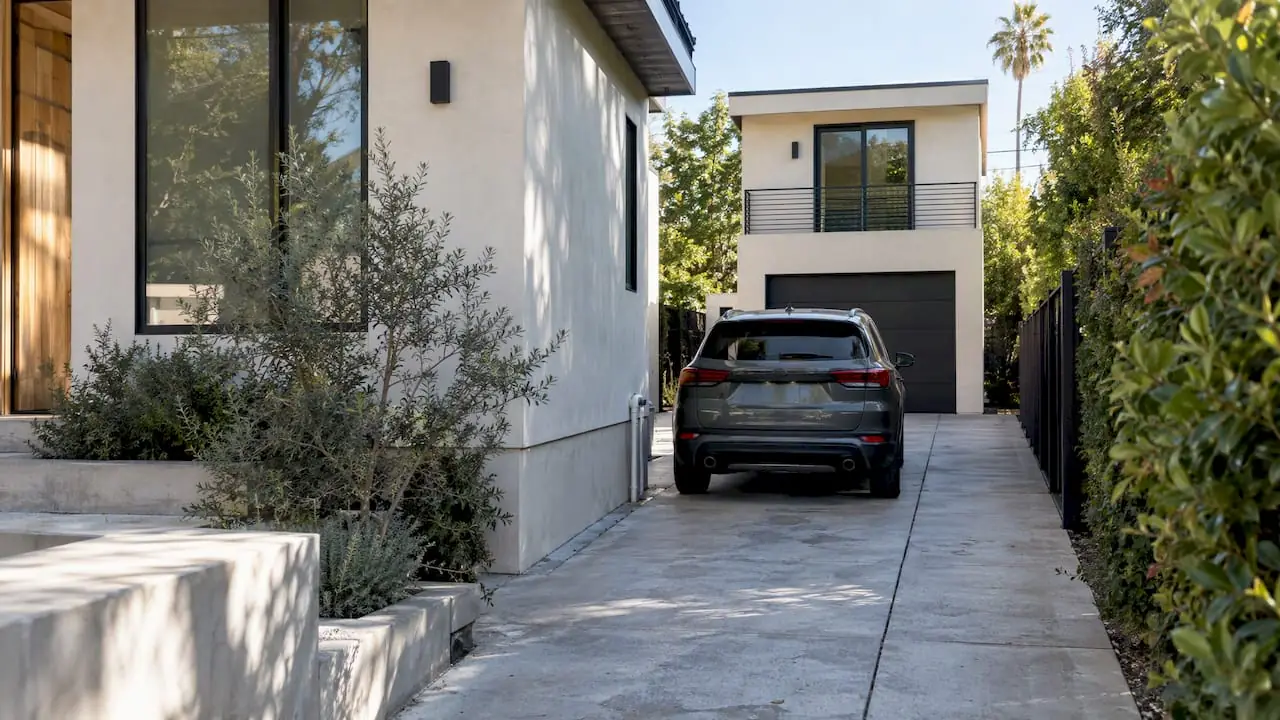
This is where the rules help homeowners most. When a garage, carport or covered parking structure is converted into an ADU, or demolished to make room for one, the city cannot require you to replace the lost parking. That applies even though the main house may then have no covered parking left.
A few practical points still matter:
- Demolition and ADU permits should move together. If you are tearing down a garage to build a new ADU in its place, the demolition permit and the ADU permit are best submitted as one coordinated package so the reviewer sees the full sequence.
- Your driveway still has to work. If you plan to keep parking a car on the driveway, check that it remains long and wide enough once the ADU is in place.
- Curb cuts are separate. Adding, widening or closing a driveway approach at the street is work in the public right-of-way, which needs its own permit from the city's Bureau of Engineering.
For more on what changes when the garage becomes living space, see our guide to a garage conversion ADU.
Junior ADUs and Parking
A junior ADU is a unit of up to 500 square feet created within the walls of the existing home, often from a bedroom or an attached garage. State law does not allow cities to require any parking for a JADU. The trade-off is that JADUs carry their own rules: an efficiency kitchen, a separate exterior entrance, and an owner who lives in either the main house or the JADU.
Some owners build both a detached ADU and a JADU on the same lot. In that case the JADU still needs no parking, and the detached ADU follows the normal rule: one space at most, or none if an exemption applies. Count each unit separately on the site plan so the reviewer can see how you reached the total.
If you are still choosing between unit types, parking is rarely the deciding factor in Los Angeles. Lot size, setbacks and utilities usually matter more. Our guide to ADU setbacks in Los Angeles covers where a detached unit can sit on the lot.
When No Exemption Applies
Some lots, often in hillside neighborhoods far from bus lines, do not qualify for any exemption. You then need one space, and the usual ways to provide it are:
- A tandem space on the existing driveway, behind the main house's parking
- An uncovered pad beside the driveway, which can sit in a setback area
- A space in an existing garage that stays a garage, if you are building the ADU elsewhere on the lot
Show the space on a dimensioned site plan with its size, its distance from the property lines and the driveway width. Hillside lots also bring their own access and fire-safety requirements, so expect closer review of the driveway and street access there.
How Nearby Cities Compare
The same state exemptions apply across California, but each city documents and reviews them in its own way. Beverly Hills applies the state exemptions through its own planning department and ADU guides, separate from LADBS. West Hollywood has its own process too, covered in our post on West Hollywood ADU parking. Cities in Orange County, such as Irvine and Newport Beach, add their own local standards on top of state law. If your address is not inside the City of Los Angeles, the city's own building department is the authority, not LADBS.
Common Mistakes That Delay ADU Parking Approval
- Stating "near transit" without a dated walking-route map
- Measuring distance as a straight line instead of the walking route
- Filing the garage demolition separately from the ADU, which confuses the review sequence
- Site plans without driveway widths or distances to property lines
- Assuming an address is in the City of Los Angeles when it is in a separate city or unincorporated county land
Parking and Rentability
Even when the city requires no parking, think about how your tenant or family member will actually park. In dense neighborhoods with tight street parking, an ADU with an assigned driveway spot can be easier to rent and lead to fewer disputes. Spell out parking in the lease: which space is theirs, whether guests can use the driveway, and any street permit rules.
California's Department of Housing and Community Development publishes an ADU handbook that summarizes the state rules, available through hcd.ca.gov. Local details can change, so confirm your lot with LADBS or City Planning before you finalize the design.
How Mr Build Helps With ADU Parking in Los Angeles
Mr Build Co. has delivered more than 50 ADUs, and parking is one of the first things we check on a site visit. We confirm which exemption your lot qualifies for, prepare the maps and site plan the plan checker needs, and coordinate garage demolition with the ADU permit when both are in scope. Design, plans, engineering and permits are handled through our in-house team and partners, with a dedicated project manager from start to final walkthrough.
Learn more about our ADU and addition services and our work in Los Angeles, or book a free on-site consultation to find out exactly where your property stands on parking before you file.
Sources and further reading
- California Government Code §66322 leginfo.legislature.ca.gov
- assessor.lacounty.gov: adu assessor.lacounty.gov
- Beverly Hills planning beverlyhills.org
- interior door replacement onedaydoorsandclosets.com
- CalHFA ADU program page calhfa.ca.gov