


The best way to communicate with a contractor is to agree on the rules before the work starts: one point of contact, a written scope, a regular meeting with a written summary, and signed change orders for every adjustment. Friendly phone calls help, but they are not a record. A shared written record is what keeps a kitchen, bathroom, ADU or addition on track when the schedule gets busy.
This guide is written for Los Angeles and Orange County homeowners. It covers what to settle before you sign, how to keep day-to-day communication calm, what not to tell a contractor, which warning signs to watch for, and what to do if things go wrong.
TL;DR
- Put everything in writing: scope, materials, dates, permit responsibility, warranties and the process for changes. California’s CSLB calls a written agreement one of the most important communication tools between homeowner and contractor.
- Agree on one point of contact and a weekly or biweekly meeting, followed by a short written summary.
- Never approve a change by text or in conversation alone. Sign a change order first.
- Treat vague answers about licensing, insurance, permits or change procedures as a red flag.
- If communication breaks down, save the record and notify the contractor in writing before you escalate.
Table of Contents
- Why communication problems start before construction does
- Start with a contract that does the talking
- Set the rhythm: who, when and how
- Keep a simple project record
- What not to tell a contractor
- Red flags in how a contractor communicates
- Questions to ask before you hire
- Extra clarity for ADUs, additions and demolition and rebuild
- Our perspective: communication is part of the build
- Working with Mr Build Co.
- When communication breaks down
- FAQ
- Sources
Why communication problems start before construction does
Most frustration on a remodel does not come from one big mistake. It comes from small gaps: a tile choice nobody confirmed, an inspection nobody scheduled, a “yes, we can add that” said on a walkthrough and never written down.
State consumer-protection guidance makes the same point. The Iowa Attorney General’s home improvement page stresses getting the details in writing, because written scope, permit responsibility, cleanup, schedule terms and change procedures turn loose expectations into obligations both sides can check. Clarity matters more than friendliness. A warm contractor who documents nothing is harder to work with than a reserved one who documents everything.
So the first job is not learning how to talk to your contractor. It is deciding what the two of you will treat as the official record.
Start with a contract that does the talking
A good contract answers questions before you have to ask them. For a Los Angeles renovation, look for these items spelled out:
- Scope of work: what is included, room by room or phase by phase.
- Materials: brands, models, finishes or clearly defined allowances.
- Start and completion dates, and what counts as an allowable delay.
- Payment schedule tied to stages of completed work.
- Permit responsibility: who applies, who pays the fees, who meets the inspector.
- Warranties and what they cover.
- The change process: how any adjustment is requested, priced and approved.
CSLB explains that California home-improvement contracts must be in writing once a project passes a small threshold, which covers essentially every kitchen, bathroom, ADU or addition. It also says that every change to the scope or price must be a written change order signed before the change is made, and that verbal promises should be placed in the contract. If you want a second perspective on why a written agreement should be the foundation of the relationship, this overview of working with a custom design and installation company shows how itemized, written project details support a smooth install.
Before signing, ask for time to read the contract. The FTC notes that a trustworthy contractor can provide proof of license and insurance, explain differences between estimates, and give you a complete contract to review. A contract with blank spaces, or pressure to sign the same day, is a conversation to end, not to continue.
Verify before you trust
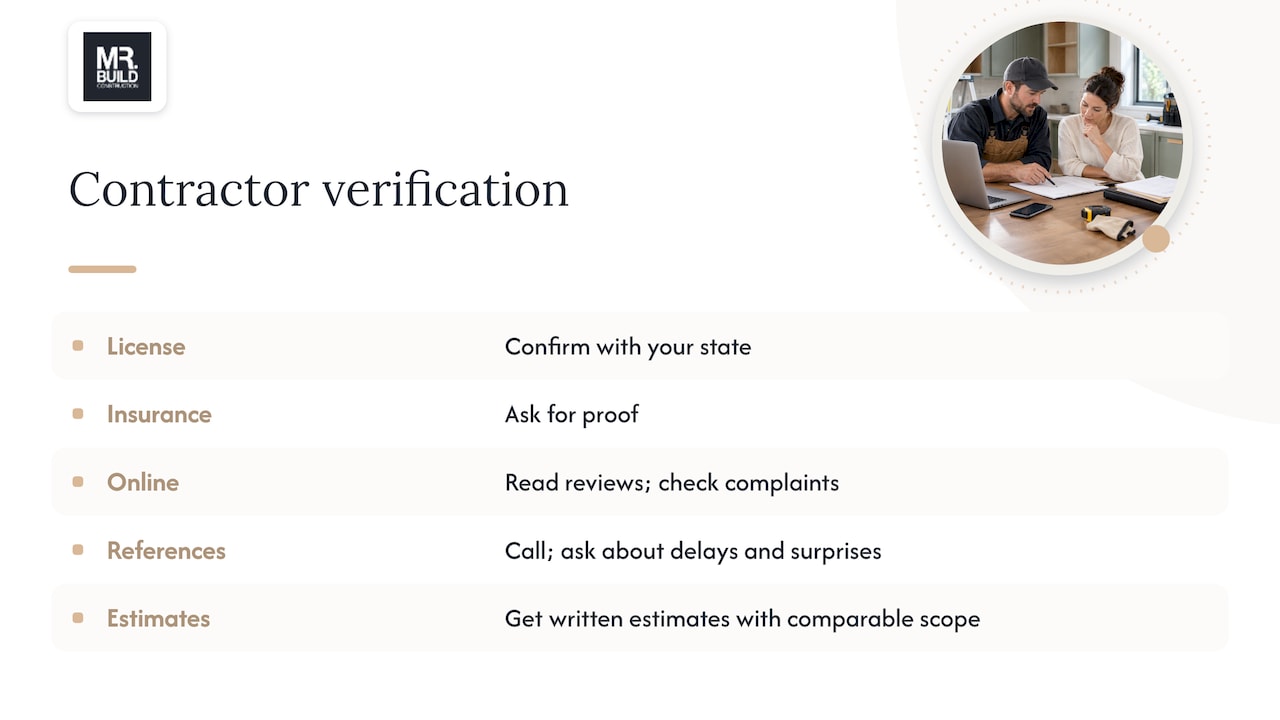
Communication also means asking for proof and getting it promptly. The FTC recommends considering only licensed and insured contractors, confirming the license with your state, and asking for proof of insurance. The NAIC adds that you should search for the company online, read reviews and check complaint history. Ask for references and call them. Ask each reference how the contractor handled questions, delays and surprises, not only whether they liked the finished space.
Get written estimates from several firms with a comparable scope. Federal hiring guidance suggests asking each firm to explain differences between estimates. How a contractor explains those differences tells you a great deal about how they will communicate later.
Set the rhythm: who, when and how
Once the contract is signed, agree on the communication system in the first meeting. Four decisions cover most of it.
1. One point of contact on each side
If you and your spouse each text the project manager with different requests, the crew gets conflicting instructions. Choose one person on your side to give approvals. Ask the contractor who your single contact is, and who covers when that person is on another site.
2. A scheduled meeting
A weekly or biweekly project meeting keeps questions from interrupting jobsite work. Connecticut’s consumer guidance recommends meeting to review the contract and keeping a signed copy, and the same habit of documenting schedules, materials and inspections applies in California. Fifteen to thirty minutes on site or by video is usually enough.
3. A written summary after every meeting
The summary is what turns a conversation into a record. A useful one lists:
- Work completed since the last meeting
- Next milestones and expected dates
- Decisions needed from you, with deadlines
- Inspections scheduled or passed
- Design or material selections confirmed
- Schedule risks
- Who owns each action
If the contractor sends it, read it and reply with corrections the same day. If it is wrong and you stay silent, you have effectively agreed to it.
4. A channel for quick questions
Text works well for small, time-sensitive items: “Is the plumber arriving Tuesday?” or “Can you confirm the paint color is on the list?” Keep texts short and specific, and attach a photo when you can. Anything that changes scope, schedule or materials moves from text to a written change order.
Keep a simple project record
You do not need software. A shared folder and a running decision log are enough. The CSLB’s guidance on contracts explains that a written agreement helps prevent misunderstandings about how the work will be done, when, and with what materials. Extend that idea through the whole job:
- The signed contract and every signed change order
- The decision log: date, what was decided, who approved
- Dated photos at key stages, especially before walls close
- Permit documents and inspection results
- Meeting summaries and key emails
- Lien waivers as payments are made (our guide to California lien waivers and when to sign them explains the forms)
The record protects both sides. A contractor with a clean log can show exactly what was approved, and you can see exactly what you agreed to.
What not to tell a contractor
This is a question homeowners often ask, and it is rarely about secrets. It is about avoiding statements that create confusion or weaken your position. Official guidance, such as Montgomery County’s consumer protection office, repeatedly flags blank spaces, verbal promises, unclear permits and incomplete design or material choices. Translated into conversation:
- “This is the final list” when it is really a wish list. Say which items are firm, which are open, and by what date you will decide.
- “Go ahead, I’ll sign off on it later.” Verbal approvals of changes are exactly what a change order exists to replace.
- “We probably don’t need a permit.” Do not say permits are unnecessary unless it has been verified. Ask who is responsible for permits and get the answer in the contract.
- “Just put in an allowance, we’ll figure it out.” Unspecified allowances and blank contract lines lead to disputes. Name the item, the selection deadline and the person who approves it.
What to say instead: name your priorities, list unresolved selections, state decision deadlines, and say who has authority to approve changes in writing.
Red flags in how a contractor communicates
Communication style is one of the clearest early signals. The CSLB’s 2025 construction checklist says changes should be written and signed, and FTC guidance identifies several scam indicators. Watch for:
- Pressure to sign immediately
- Reluctance to show a license or proof of insurance
- No detailed written scope
- Change orders that are verbal only
- Requests for payment by cash, wire transfer, gift cards, cryptocurrency or payment apps
- A contract with blank lines
- Slow or evasive answers to direct questions during the estimate stage
That last one deserves weight. If a contractor takes a week to return calls while trying to win your business, expect it to be slower once the job is won. For another homeowner-facing look at warning signs, this guide to choosing a contractor for an outdoor project covers many of the same principles.
Questions to ask before you hire
Good questions let the contractor explain usual practice and give you a chance to respond. Bring these to the first meeting:
- Who will be my day-to-day contact, and how quickly do you respond to messages?
- How often will we meet, and how will you document decisions?
- Who pulls permits and schedules inspections?
- How do you handle a change I request mid-project?
- What happens if a material is delayed or the crew finds a hidden problem?
- Who will be on site daily, and who supervises them?
- What is the process if I am unhappy with something?
You are not interrogating. You are learning whether their system matches your expectations.
Extra clarity for ADUs, additions and demolition and rebuild
Larger projects have more moving parts, and the gaps tend to appear in the logistics rather than the design. CSLB’s checklist points to permit responsibility, cleanup, debris removal, site security, inspections, materials and allowable delays as contract items. For an ADU, addition or full rebuild, ask in writing:
- Permits and inspections: who applies, who attends, and what happens if an inspection fails.
- Utilities: who coordinates connections and which tasks sit with you. Our article on three tasks to outsource when connecting ADU utilities in California is a good starting point.
- Site security and debris removal: who is responsible and how often debris is hauled.
- Special materials: what happens to the schedule if a long-lead item is late.
- Abnormal conditions: how unexpected findings, such as soil or hidden structural issues, will be reported and approved.
If you are still weighing which route fits your property, our feasibility checklist for ADU versus home addition walks through the decision, and the home remodel timeline by milestones shows where decisions typically fall so you can plan your approvals.
Our perspective: communication is part of the build
We see communication as a construction task, as real as framing or insulation. It needs a plan, an owner and a schedule. Homeowners usually come to us with a clear picture of the finished space and less clarity on the sequence of decisions that gets them there. Our job is to make that sequence visible.
In practice, that means integrating design, planning, permitting and project management so you are not coordinating separate parties. When one team is responsible for the plan, the permit path and the schedule, questions have a single place to land, and answers do not get lost between trades.
We encourage clients to ask for the things we would want if we were in their position: a clear scope, a defined point of contact, regular updates, and written confirmation of changes. A homeowner who knows what is happening each week is calmer, and a calm homeowner makes better decisions. Our clients’ testimonials most often mention clear communication and organized project management, and we treat that as the standard to keep earning.
One habit we would recommend on any project, with any contractor: before a decision is final, ask, “Can you put that in writing so we are both looking at the same thing?” A good contractor will say yes without hesitation.
— David S.
Working with Mr Build Co.
If you are planning a remodel or new construction in Los Angeles or Orange County, we would be glad to talk through your project and explain how we structure planning, permitting and communication from the first meeting. Explore our kitchen remodeling, bathroom remodeling, ADU and additions and complete home remodeling services, or schedule a consultation to start the conversation.
When communication breaks down
Even with a good system, things can slip. Respond in this order.
- Reread the contract and your record. Is the issue covered by the scope, schedule or change process?
- Raise it directly, briefly and in writing: what you observed, what the contract says, what you are asking for and by when.
- Request a meeting with the contractor’s project manager or owner.
- Send a formal written notice if the issue continues. CSLB says it will ask whether you formally notified the contractor and recommends saving a copy of the letter, with a sample available on its site.
- File a complaint with the CSLB if the problem remains. CSLB notes that enforcement does not guarantee restitution, so keep expectations realistic.
Stay factual in every message. Dated photos and signed documents carry more weight than strong language.
FAQ
What should you not tell a contractor?
Do not present an undecided wish list as the final scope, promise to approve changes verbally later, or say permits are unnecessary without verifying. Also avoid agreeing to a blank contract or an unspecified allowance. Share your priorities and deadlines instead.
What are the red flags when hiring a contractor?
Pressure to sign immediately, no proof of license or insurance, no detailed written scope, and verbal-only changes are the main ones. Requests for cash, wire transfers, gift cards, cryptocurrency or payment apps are also warning signs. Slow, vague replies before you hire are worth taking seriously too.
How often should you hear from your contractor?
Agree on this at the start. A weekly or biweekly meeting with a written summary works well for most remodels, with text or phone for quick scheduling questions. The contract or kickoff notes should record the rhythm so both sides can hold to it.
Is a text message enough to approve a change?
No. California’s CSLB says changes to scope or price should be written change orders signed before the work is done. A text can start the conversation, but the signed change order is the approval.
Sources
- CSLB: Learn About Home Improvement Contracts
- CSLB: Contracts and Binding Agreements
- CSLB: Construction Checklist 2025
- CSLB: Filing a Construction Complaint
- FTC: How To Avoid a Home Improvement Scam
- NAIC: How can I avoid getting scammed by a contractor
- Hiring a Contractor (federal guidance)
- Iowa Attorney General: Home Improvement & Contractor Tips
- Montgomery County Office of Consumer Protection: How to Hire a Home Improvement Contractor
- Connecticut DCP: Working With a Home Improvement Contractor

