


California homeowners building an accessory dwelling unit in 2026 can tap federal mortgage rules that count projected ADU rent toward qualifying income, though the statewide CalHFA grant round has been fully allocated. Realistic routes now include FHA, Fannie Mae, or Freddie Mac underwriting paired with a construction or renovation loan, plus local city programs. The smart first moves: ask an ADU-savvy lender about rental income rules, confirm any CalHFA partner claims directly with the agency, and loop in your contractor before you apply.
TL;DR:
- Lenders generally cap ADU rent at 30% of qualifying income, subtract vacancy allowances, and require appraisals supported by comparable rentals, sometimes including another ADU.
- CalHFA reimbursements historically covered eligible predevelopment costs up to $40,000 through approved partners and escrow, not direct homeowner payments; verify partner status with the agency.
- Local programs may offer deferred loans, but eligibility can hinge on income limits, credit scores, funding availability, or long term affordable rent commitments.
- Choose construction loans for new detached units, rehabilitation financing for conversions, and home equity options after weighing draw schedules and mortgage term tradeoffs.
- Lenders typically request signed contractor bids, a clear work scope and timeline, rent comparables or Form 1007, plus standard income and ownership records.
Table of Contents
- How FHA, Fannie Mae, and Freddie Mac Treat ADU Rental Income
- What Happened to the CalHFA ADU Grant and Where It Stands Now
- Finding Local ADU Loan and Grant Programs Near You
- Which Loan Type Fits Your ADU Project
- What Lenders Want to See Before They Count Your ADU Rent
- Coordinating Your Contractor and Lender So Nothing Stalls
- Why Financing Deserves a Seat at the Planning Table
- How We Help You Build a Financing-Ready ADU Project
- FAQ
- Sources
How FHA, Fannie Mae, and Freddie Mac Treat ADU Rental Income
Federal mortgage policy shifted meaningfully for ADU owners starting in late 2023, and the rules still shape underwriting today. The Federal Housing Administration expanded access to mortgage financing for homes that have or will include an accessory dwelling unit, allowing lenders to count actual or projected ADU rental income when qualifying a borrower. That guidance, detailed in FHA INFO 2023-81, also clarified that ADU work can move forward under FHA rehabilitation or new-construction programs, not just as a standalone purchase feature.
Fannie Mae and Freddie Mac provide parallel guidance that lets lenders include ADU rental income in qualifying income, though both set limits and appraisal conditions. Lenders typically apply these practical rules:
- Rental income from an ADU is commonly capped so it cannot exceed 30% of the borrower’s total qualifying income.
- Appraisers must document the ADU specifically and support estimated market rent with comparable rentals, often requiring at least one comparable that also includes an ADU.
- A vacancy allowance is applied before the rent counts toward income, which lowers the usable figure below the full projected rent.
One of the clearest shifts in agency policy is that rent no longer has to be collected to count. Under the FHA guidance, projected rent on a unit that does not yet exist can support a mortgage application, provided the appraisal backs it up. That single change opened financing to homeowners building a new ADU rather than only those refinancing an existing one. The practical effect: your appraisal does more work than before, and a thin or poorly comped rent estimate can shrink your qualifying income regardless of what the agency rule technically allows. For a deeper look at how the 30% cap plays out in real underwriting files, see our breakdown of ADU rental income after the lender cap.
What Happened to the CalHFA ADU Grant and Where It Stands Now
The CalHFA ADU Grant was built to cover predevelopment and closing costs up to $40,000, reimbursing homeowners for expenses like site plans, architectural drawings, permit fees, and soil tests before construction even started. CalHFA never handed homeowners a check directly. Funds moved through a network of approved lenders and partners, who verified eligible costs and processed reimbursements as part of a managed transaction.
That structure matters because the most recent round of statewide funding was fully allocated as of December 28, 2023, according to CalHFA’s own program page. Homeowners should treat any claim of guaranteed, open grant access with real skepticism until CalHFA confirms a new funding round publicly.
- Grant dollars flow through escrow accounts tied to the construction loan, not into a homeowner’s personal bank account.
- Approved lenders and partners verify invoices and project documentation before any reimbursement is released.
- CalHFA has flagged scam attempts where third parties falsely claim grant access or try to bypass the verified partner process.
Pro Tip: Confirm any lender’s “CalHFA-approved” status directly through CalHFA’s own partner listing before signing anything or paying a deposit tied to grant promises.
Finding Local ADU Loan and Grant Programs Near You
State-level funding may be tapped out, but cities and counties across California have run their own ADU financing programs, and new ones appear as local housing departments shift priorities. These programs tend to fall into a few recognizable shapes: low-interest deferred loans, construction loans with below-market terms, and programs that trade favorable financing for a commitment to rent the ADU at an affordable rate.
Pasadena offers one example. The city launched a low-interest loan program through its Second Unit ADU initiative, structuring construction loans with deferred payments for homeowners willing to commit to specific tenant restrictions. San Diego runs a different model through the San Diego Housing Commission’s ADU Finance Program, which has historically offered construction-to-permanent loans while prioritizing limited funding using credit score thresholds and area median income rules, often on a first-come basis.
If you want to check what is active where you live, work through this sequence:
- Contact your city or county housing department directly and ask whether an ADU loan or grant program is currently funded and accepting applications.
- Verify program dates, since many local programs open and close funding rounds throughout the year without much public notice.
- Ask about AMI limits or deed restrictions tied to the funds, since several programs require the ADU to rent at an affordable rate for a set number of years.
- Request the program’s official documents in writing rather than relying on a verbal summary from a call center.
Which Loan Type Fits Your ADU Project
The right financing route depends heavily on whether you are building new, converting existing space, or working from home equity you already have. Four pathways cover most California ADU projects.
Construction-to-permanent loans suit ground-up detached ADUs or any project involving significant new construction. The lender releases funds in draws tied to construction milestones, then the loan converts automatically into a standard mortgage once the ADU receives its certificate of occupancy. This structure requires close coordination with your contractor’s draw schedule, since missed inspections or delayed paperwork can stall a disbursement.
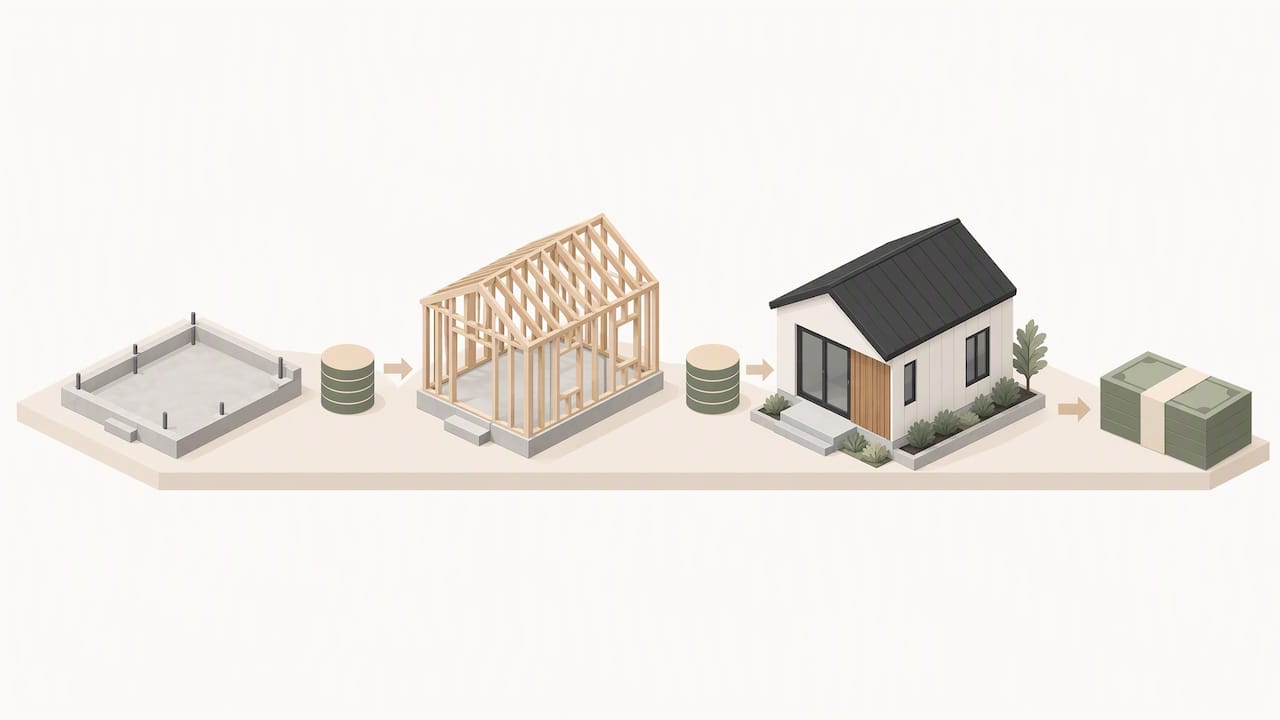
FHA 203(k) and other rehabilitation loans work well for garage conversions or substantial remodels that will become a rentable ADU. These programs roll renovation costs into the mortgage and, under current FHA guidance, allow the projected ADU rent to support qualifying income once the appraisal documents it properly.
Cash-out refinances and HELOCs give homeowners with built-up equity a straightforward way to fund ADU construction without a separate construction loan structure. A cash-out refinance replaces your existing mortgage with a larger one and hands you the difference in cash, while a HELOC acts more like a revolving credit line you draw against as costs come in. Both come with rate and term trade-offs worth discussing directly with a lender before committing, since refinancing resets your mortgage terms entirely.
Private lenders, DSCR loans, and bridge financing fill gaps when conventional options do not fit the timeline or the borrower’s financial profile. These routes are typically aimed at real estate investors rather than owner-occupants, since DSCR underwriting qualifies the loan based on the property’s rental income rather than the borrower’s personal income. Homeowners who hit a wall with traditional lenders sometimes look at private financing options, like those outlined in this overview of ADU construction financing paths, when conventional underwriting timelines do not match a project’s construction schedule.
- Construction-to-perm loans fit new detached ADUs built from the ground up.
- FHA 203(k) and rehab loans fit conversions of existing garages or attached space.
- Cash-out refinancing and HELOCs fit homeowners sitting on substantial home equity.
- Private and DSCR lenders fit investor-focused projects or gaps conventional lenders will not cover.
What Lenders Want to See Before They Count Your ADU Rent
Lenders asking you to count ADU rent as qualifying income will request a specific documentation package, and gathering it early speeds up the whole process. Expect to provide a detailed contractor scope of work and construction timeline, signed contractor bids, rent comparables or a completed Form 1007 rent schedule, a lease template if the unit is already occupied, proof of property ownership, and your standard borrower income documents.
- A signed contractor agreement with a clear scope of work and realistic timeline.
- Rent comparables or a Form 1007 rent schedule supporting the projected ADU rent.
- A lease template or existing lease if the ADU is already rented.
- Standard income and ownership documentation your lender requires for any mortgage file.
Appraisal requirements get specific attention under agency guidance. Appraisers must describe the ADU itself, pull comparable rentals to support market rent, and in many agency guides, at least one comparable property also needs its own ADU to be considered a valid match.
Credit score expectations vary by program and loan type, and local programs frequently add their own layer of AMI limits or deed restrictions tied to affordable rent commitments.
Coordinating Your Contractor and Lender So Nothing Stalls
Financing and construction move on two different clocks, and the projects that stay on track are the ones where both clocks are synced from day one. A typical sequence runs through predevelopment work, permit submission, a completeness review from the local building department, construction loan draws tied to inspection milestones, final inspections, a certificate of occupancy, and then final loan disbursement or conversion.
Working with a contractor who already understands CalHFA partner processes and managed construction escrow cuts down on rework and funding delays, since draw requests need to match what inspectors and lenders expect to see at each stage. Misaligned paperwork between a contractor’s invoice and a lender’s draw request is one of the most common reasons a disbursement gets held up.
- Predevelopment and permit review typically take the longest and the most unpredictable stretch of the timeline.
- Construction draws release in stages tied to verified progress, not a single lump payment.
- Final disbursement or loan conversion happens only after the certificate of occupancy is issued.
Pro Tip: Treat any unsolicited promise of guaranteed grant money or a request to bypass your escrow process as a red flag, and verify partner status directly with CalHFA or your local housing department before moving forward.
Why Financing Deserves a Seat at the Planning Table
Homeowners often treat financing as a separate box to check after they have already settled on a contractor and a design. We’d push back on that order. The loan structure you choose shapes your draw schedule, your documentation burden, and how much flexibility you have if the project timeline shifts, which it often does.
An ADU is a long-term asset, whether you plan to rent it, house family, or simply add value to the property. The homeowners who get the smoothest outcome are the ones who bring their lender and their contractor into the same conversation early, rather than finalizing financing in isolation from the build itself. Integrated planning is not a luxury step. It is what keeps a project moving when permit timelines or appraisal requirements shift underneath you.
— David S.
How We Help You Build a Financing-Ready ADU Project
Securing the right loan is only half the work. The other half is making sure your project actually qualifies, with a scope of work, timeline, and documentation that hold up under lender scrutiny from day one. We build that readiness into every ADU project we take on.

We handle the pieces that typically slow homeowners down when they try to coordinate financing and construction on their own:
- Integrated design and permitting support so your ADU plans match what your lender and local building department expect to see.
- Coordination with your lender on draw schedules helps ensure construction milestones and disbursement requests stay aligned.
- Project management through all phases, reducing the back-and-forth that stalls funding.
If you are ready to turn financing approval into an actual build, reach out through our ADU / Additions page to start a project plan built around your lender’s requirements and your property’s layout.
FAQ
Is there a $40,000 ADU grant available in California right now?
The CalHFA ADU Grant historically reimbursed up to $40,000 in predevelopment and closing costs, but the most recent statewide funding round was fully allocated as of December 28, 2023. Homeowners should confirm directly with CalHFA whether a new funding round has opened before relying on this program.
Will there be a free ADU grant program in California in 2026?
CalHFA has not published confirmation of a new funded round beyond the allocation that closed in late 2023, based on the agency’s own ADU program page. Local cities and counties, including programs like San Diego’s and Pasadena’s, may still offer their own loans or grants, so checking with your local housing department is the most reliable next step.
How much does a 500 square foot ADU cost in California?
Construction costs vary widely based on design, site conditions, finishes, and location, and no single published figure applies statewide. A licensed contractor who evaluates your lot and plans can provide an accurate project estimate specific to your situation.
What is the best way to finance an ADU in California?
There is no single best route. It depends on whether you are building new construction, converting existing space, or drawing on home equity, with options ranging from construction-to-permanent loans and FHA 203(k) financing to cash-out refinancing, HELOCs, and local municipal programs. Many homeowners also explore whether their ADU’s projected rental income can help them qualify under FHA, Fannie Mae, or Freddie Mac underwriting rules.
How do lenders verify ADU rental income for mortgage qualification?
Lenders typically require an appraisal that documents the ADU and supports projected rent with comparable rental properties, often including at least one comparable that also has an ADU.
Sources
- Federal Housing Administration Expands Access to Mortgage Financing for Homes That Have or Will Include Accessory Dwelling Units
- FHA INFO 2023-81 October 16, 2023
- ADU for Lenders | ADU Grant | CalHFA
- ADU Finance Program (San Diego Housing Commission)

