


Yes, you can often stay home during a remodel when the work is confined to one area, your bathroom and kitchen stay usable, and no one in your household faces special health risks. Staying becomes impractical when a project touches whole-house systems, disturbs lead paint or asbestos, or takes out every bathroom and kitchen at once. Guidance from EPA Renovate Right and NIOSH, along with how we plan occupied projects at Mr Build Co., shapes this answer.
TL;DR:
- For homes built before 1978, disturbing painted surfaces requires lead safe practices; require an EPA certified renovator, the Renovate Right pamphlet, and documented cleaning verification.
- Require floor to ceiling barriers, a double door entry vestibule, negative pressure with HEPA filtration, sealed HVAC registers, and daily HEPA vacuuming before staying onsite.
- Ask the contractor for written phased occupied and vacant site schedules; occupied work can take longer because crews remobilize between phases.
- Relocate during whole house rewiring, repiping, HVAC replacement, hazardous material removal, or periods when every bathroom and the kitchen are unusable.
Table of Contents
- Quick checklist: the five questions that decide stay vs move-out
- How to keep your family safe and functional if you stay
- When moving out is the right move, and where to stay temporarily
- What to require from your contractor: phasing, schedule, and lead-safe practices
- How a remodeling contractor plans occupied work: our checklist and milestones
- Safety measures for children and pets during remodeling
- Storage solutions for furniture and belongings during remodeling
- Noise management strategies to reduce disturbance while living in the home
- Financial planning tips for unexpected costs during the remodel
- Author’s takeaway and next steps
- If you want help planning an occupied remodel, here’s where we fit in
- FAQ
- Sources
- Authoritative sources
Quick checklist: the five questions that decide stay vs move-out
Before you sign a contract, five questions settle most stay-or-go decisions. These questions are often reviewed with homeowners at the design meeting because the answers change the drawings, the schedule, and what the crew needs to do every morning.
- Is the work confined to one room or wing, or does it touch the whole house?
- Will water, power, or HVAC be unavailable or unsafe during any phase?
- Does your household include young children, a pregnancy, or someone with severe asthma or another condition sensitive to dust?
- Does the scope disturb painted surfaces, flooring, or materials that could trigger lead or asbestos rules?
- Can the contractor seal off the work zone completely and give the crew a separate way in and out?
A single “no” on utilities or health risk usually outweighs a “yes” on everything else. If your home was built before 1978 and the work disturbs painted surfaces, federal rules require lead-safe practices regardless of how small the project feels, and that alone can tip the decision toward staying with strict containment rather than moving out.
Utility interruptions deserve their own conversation. A kitchen remodel that only shuts off water to one sink is very different from a repipe that leaves the whole house without running water for days. It is important to map exactly which days each utility will be down, not just which weeks.
Pro Tip: Bring this five-question list to your first design meeting and ask your contractor to answer each one in writing before you sign anything.
How to keep your family safe and functional if you stay
Staying home during construction works when you treat containment as a non-negotiable part of the contract, not an afterthought the crew handles informally.
- Set up a sealed refuge room. Pick a bedroom or living area away from the work zone, keep it off-limits to the crew, and run a dedicated HEPA air purifier there around the clock.
- Require real containment, not plastic sheeting alone. Ask for floor-to-ceiling barriers, a double-door vestibule the crew uses to enter and exit, and taped seams at every joint.
- Insist on negative pressure and air scrubbers. NIOSH guidance recommends isolating renovation areas with physical barriers and using negative pressure with HEPA filtration so contaminated air moves out of, not into, occupied spaces.
- Protect your HVAC system. Seal supply and return registers inside the work zone, and either isolate that zone from the shared system or run supplemental filtration in the rooms you occupy.
- Plan a temporary kitchen or bathroom. A folding table with a portable sink, an electric cooktop, and a relocated refrigerator can carry a household through a kitchen remodel; a restroom trailer is a practical stand-in when a bathroom remodel takes your only full bath offline.
- Clean daily and verify before containment comes down. HEPA vacuuming and wet-wiping every work day keeps dust from spreading, and a signed cleaning verification with photos before the barriers are removed confirms the space is genuinely ready to reoccupy.
NIOSH case studies describe real consequences when containment fails: occupants near active renovation zones reported headaches, sinus problems, dizziness, and respiratory irritation tied to contaminated air moving into the spaces where they lived and worked. That is the exact outcome a sealed refuge room, negative pressure, and daily cleaning are designed to prevent.
For the painting and drywall phases specifically, preparing your home before the crew arrives by clearing furniture and covering fixed surfaces cuts down on both dust and cleanup time.
Pro Tip: Ask your contractor for a written cleaning verification checklist, signed and dated, before any containment wall comes down.
When moving out is the right move, and where to stay temporarily
Some projects make staying home impractical no matter how good the containment is. Whole-house system replacements like rewiring, repiping, or HVAC overhauls, simultaneous loss of every bathroom and the kitchen, and any hazardous-material abatement are the clearest triggers to relocate, even temporarily.
A short relocation during the worst stretch, rather than for the whole project, is a common middle path: many households stay home for most of the timeline and only leave during the heaviest demolition or utility shut-off days.
- Extended-stay hotels and furnished short-term rentals suit stays of a few days to several weeks and usually include a kitchenette.
- Staying with family or friends works well for shorter gaps and keeps costs predictable.
- RV or mobile-home rentals can park on-site, which keeps you close to the job and your belongings.
- Short-term apartment leases fit longer whole-home projects where you need more space and stability.
Extended Stay America’s guidance on temporary housing during renovation lists these same categories as the most commonly used options for households displaced by construction.
| Option | Typical length of stay | Best fit |
|---|---|---|
| Extended-stay hotel | Days to weeks | Small households wanting kitchenette access |
| Furnished short-term rental | Weeks to months | Families needing more space and privacy |
| Staying with family or friends | Days to weeks | Short, high-disruption phases |
| RV or mobile-home rental | Weeks to months | Staying close to the job site |
| Short-term apartment lease | Months | Whole-home projects with a longer timeline |
Before you leave, arrange storage for anything in the work zone, confirm how the crew will access the house while you’re away, and get a written return date along with a plan for re-entry cleaning verification. Weigh each option against how long you’ll be gone, whether you have pets, and how close you want to stay to the job site.
What to require from your contractor: phasing, schedule, and lead-safe practices
The clearest way to compare staying versus moving out is to ask for two schedules, not one. A phased-occupied schedule and a vacant-site schedule from the same contractor show you the real tradeoff in time and sequencing for your specific project. Architect-practitioner guidance on occupied remodels points out that phased work typically adds duration because trades remobilize between phases, so asking for both numbers upfront avoids surprises later. You can see how these phases typically line up in a home remodel timeline by milestones.
Once you’ve decided, your contract should spell out:
- Containment specs: barrier type, vestibule location, and taped-seam requirements.
- Negative-pressure and filtration requirements, including who maintains the air scrubbers.
- A written cleaning verification step before any containment comes down.
- The crew’s entry and exit path, separate from your family’s daily routes.
- Advance notice for any utility shutdown, including exact dates and expected duration.
If your home was built before 1978 and the project disturbs painted surfaces, the contract should also confirm the crew includes an EPA-certified renovator, that you’ve received the Renovate Right pamphlet, and that cleaning verification is part of the deliverables, not an optional extra.
Finally, ask for a single point of contact, a set cadence for updates, such as a daily text or weekly walkthrough, and a documented way to raise health or comfort complaints if something feels off.
Pro Tip: Request both a phased-occupied bid and a vacant-site bid in writing before choosing, so you’re comparing real numbers instead of guesses.
How a remodeling contractor plans occupied work: our checklist and milestones
When a homeowner decides to stay home, the drawings, phasing, and pricing conversations change from day one. Documentation of which rooms stay live, where temporary systems go, and how the crew moves through the house without crossing into occupied space is prepared.
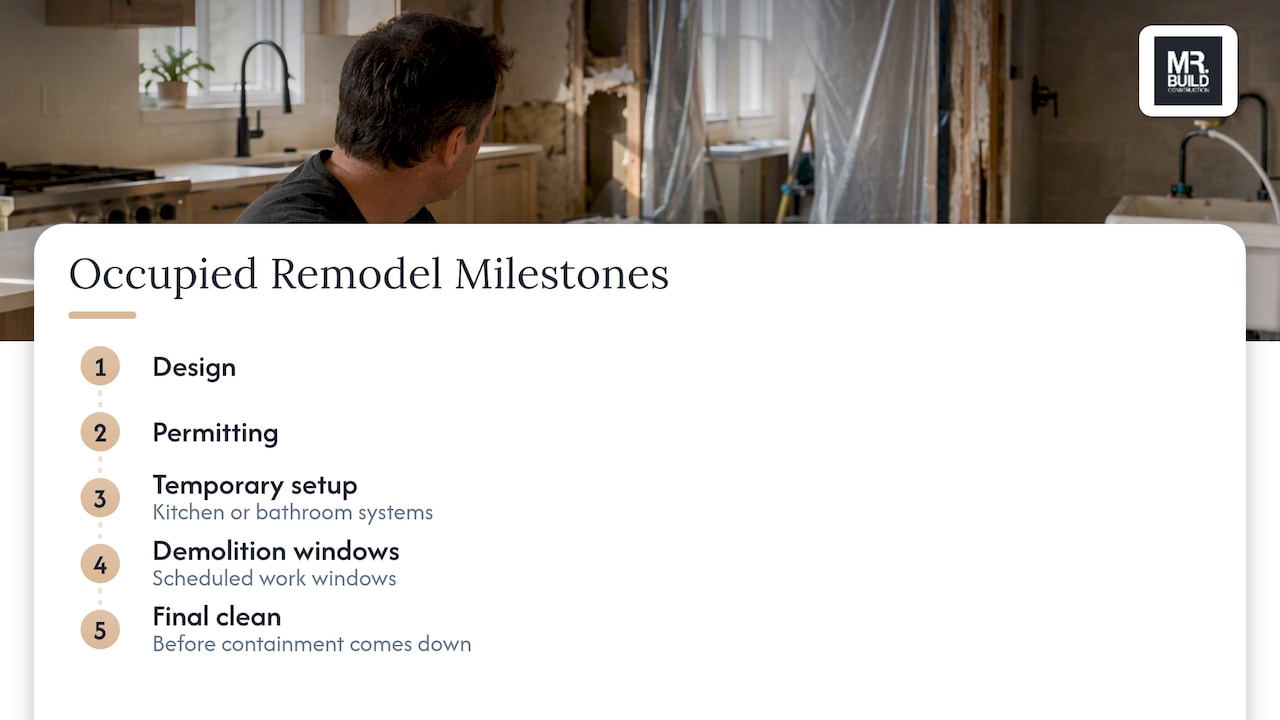
A typical sequence runs design, permitting, setup of temporary kitchen or bathroom systems, scheduled demolition windows, and a final clean before containment comes down. Each milestone has a clear owner, and daily logs, sign-off sheets for containment, and a cleaning verification record help keep track of project progress.
Safety measures for children and pets during remodeling
Construction sites and curious kids or pets don’t mix well, so the refuge room concept extends naturally into a safety plan. Keep children and pets out of the work zone entirely, and use a secondary barrier, like a baby gate or exterior pen, in addition to the crew’s containment wall.
Loose nails, exposed wiring, and power tools left overnight are common hazards, so ask your contractor to lock up tools and secure the site at the end of each day. If you have a dog that bolts through open doors, warn the crew in advance and designate one door as the only one used for deliveries and entry.
For toddlers, cover electrical outlets in adjacent rooms and tape down any temporary extension cords running through shared hallways. Pets sensitive to noise or strangers may do better in a boarding situation during the loudest demolition days, even if you’re otherwise staying home for the rest of the project.
Walk the site with your contractor each morning if you can, checking for anything left within reach of a curious child or pet overnight.
Storage solutions for furniture and belongings during remodeling
Clearing the work zone of furniture and belongings protects them from dust and gives the crew room to work safely. For a single room, moving items into a sealed interior room or garage often covers the need without extra cost.
For whole-home projects, a portable storage container placed in the driveway keeps belongings on-site and accessible, while an off-site storage unit works better when the project will stretch over months or when driveway space is needed for materials and dumpsters.
Wrap upholstered furniture and electronics in plastic sheeting regardless of where they end up, since dust travels further than most homeowners expect. Label boxes by room so unpacking after the project matches how you want the space to function, not just how it was before.
Noise management strategies to reduce disturbance while living in the home
Noise is often the most constant disruption of staying home during a remodel, more so than dust once containment is in place. Scheduling the loudest work, like demolition or framing, for consistent hours each day gives your household a predictable quiet window in the evenings.
Ask your contractor for a written daily schedule so you can plan calls, remote work, or a child’s nap around the noisiest tasks rather than being surprised by them. Closing doors between occupied and work areas, combined with a white-noise machine in bedrooms or home offices, cuts down on how much carries through shared walls.
If you work from home, consider relocating to a coffee shop, library, or co-working space during the specific days framing or demolition is scheduled, rather than trying to work through it. That targeted approach is often more manageable than planning around noise for the entire project.
Financial planning tips for unexpected costs during the remodel
Every remodel carries some risk of surprises once walls open up, whether that’s outdated wiring, water damage, or a structural issue nobody could see beforehand. Building a contingency into your overall budget before work starts gives you room to absorb a surprise without derailing the project or the decision to stay home.
Ask your contractor to flag potential cost drivers during the design phase, such as older plumbing or electrical systems that often need updates once exposed. Get any change order in writing before work proceeds, including how it affects both the schedule and your living situation, since an unexpected repair can sometimes extend the timeline enough to change whether staying home still makes sense.
If you’re staying home during the project, factor in that a phased-occupied schedule can run longer than a vacant-site schedule for the same scope, since crews remobilize between phases. Planning for that difference upfront, rather than reacting to it mid-project, keeps both your budget and your living arrangements more predictable.
Author’s takeaway and next steps
The decision to stay or go belongs at the design table, not mid-demolition. Ask for both a phased-occupied and a vacant-site schedule, and insist on containment specs and cleaning verification in writing. Before your next meeting, write down any household vulnerabilities, pick your refuge room, and list the deliverables you expect from your contractor.
— David S.
If you want help planning an occupied remodel, here’s where we fit in
Kitchen remodeling, bathroom remodeling, complete home remodeling, demolition and rebuild, and ADU and addition projects can be planned around how clients actually live during construction. When requesting an estimate, ask for a phased-occupied versus vacant-site schedule, a written containment and cleaning verification plan, and a clear communication cadence so you always know what’s happening next.

- Kitchen Remodeling
- Bathroom Remodeling
- Complete Home Remodeling
- Demolition & Rebuild
- ADU / Additions
Reach out through any of these pages to set up a planning call and talk through what staying home or relocating would look like for your specific project.
FAQ
Can you live in your house during a remodel?
Yes, in many cases, especially when the work is limited to one area and your kitchen and at least one bathroom remain usable. Whole-house system work, loss of all bathrooms and the kitchen at once, or lead and asbestos abatement usually make relocating the safer and more practical choice.
Is $50,000 enough to remodel a house?
Remodel costs vary enormously by scope, location, and the condition of what’s behind the walls, so there’s no single answer that applies across projects. The most reliable way to know what your project will cost is a detailed estimate from a contractor who has walked your specific space.
Where to stay while renovating?
Common options include extended-stay hotels, furnished short-term rentals, staying with family or friends, and RV rentals parked near the job site, each suited to different lengths of stay and family needs, as outlined in temporary housing guidance. The right choice depends on how long you’ll be displaced and how close you want to stay to the project.
Sources
- Maintaining acceptable indoor environmental quality (IEQ) during construction and renovation projects — NIOSH/CDC
- Renovate Right — EPA (lead-safe work practices)
- Temporary housing during home construction or renovations — Extended Stay America blog
Authoritative sources
These primary sources back the safety and process guidance in this article, including NIOSH’s recommendations on indoor air quality during construction, EPA’s lead-safe work requirements, and current temporary-housing practices for households displaced during a remodel.

