


California law recognizes four statutory waiver and release forms: conditional progress, unconditional progress, conditional final, and unconditional final. The rule that matters most is simple: a conditional waiver only takes effect once payment clears, while an unconditional waiver gives up your rights the moment you sign it, whether or not you have been paid. Never sign an unconditional waiver until the money is confirmed in your account.
TL;DR:
- Sign an unconditional waiver only after confirming that the payment check has cleared to prevent losing lien rights on unpaid funds.
- Always use the official, current statutory form approved by the CSLB, as deviations may render the waiver unenforceable.
- Keep thorough records, including proof of payment like cleared checks or signed acknowledgment, attached to each conditional waiver.
- Submit preliminary notices within 20 days of starting work or delivering materials to preserve lien rights, especially if payments are delayed.
- Contractors should verify payment clearance before requesting unconditional waivers and match each waiver to specific check details to avoid disputes.
Table of Contents
- The four statutory waiver and release forms explained
- Choosing between conditional and unconditional waivers at each payment
- Evidence that makes a conditional waiver legally effective
- Preliminary notices and the deadlines that protect your claim
- A checklist for collecting, verifying, and filing waivers correctly
- Common pitfalls that create risk with lien waivers
- Challenging a waiver that was signed improperly or under pressure
- How waivers interact with mechanic’s liens in California
- Why the stakes differ for subcontractors versus general contractors
- A typical payment and waiver timeline on a California remodel
- Recent developments worth watching in California lien law
- Mr Build Co. perspective: how we administer waivers on Los Angeles remodels
- Working with a contractor who manages waivers correctly
- FAQ
- Sources
The four statutory waiver and release forms explained
California’s Civil Code sets out exactly four forms, and each one answers two separate questions: is this a progress payment or the final one, and has the money actually arrived. The Conditional and Unconditional Waiver and Release Forms published by the Contractors State License Board (CSLB) confirm that any waiver used in California must substantially follow the statutory text, not a homemade version drafted by a contractor or property manager.
- A conditional progress waiver releases rights for a specific progress payment, but only once that payment clears.
- An unconditional progress waiver releases those same progress rights immediately, regardless of payment status, which is why it carries real risk for the signer.
- A conditional final waiver applies to the last payment on a contract and includes a through date marking the final day of work covered.
- An unconditional final waiver closes out the entire claim once the final payment has cleared.
Each form preserves certain exceptions, including retentions, unpaid change orders, and other contract rights that the waiver does not touch. The CSLB hosts downloadable PDFs for all four forms, and using anything other than the official language risks a waiver that does not hold up if a dispute follows.
Choosing between conditional and unconditional waivers at each payment
The decision comes down to one question: has the payment cleared the bank yet, as explained in Sign Conditional First for Residential Lien Waivers, Plus State Rules | BidWolf Blog. If it has not, the claimant signs a conditional waiver. If it has, and only then, an unconditional waiver is appropriate.
- Confirm whether the payment is a progress draw or the final payment on the contract.
- Check whether the check or electronic transfer has actually cleared, not just been issued or deposited.
- If payment has not cleared, use the conditional form tied to that specific payment amount and through date.
- If payment has cleared, the unconditional form may be signed, since it asserts that payment was received.
Mixing these up carries consequences. A subcontractor who signs an unconditional waiver before a check clears has given up lien rights on money that might still bounce or get stopped. Picture a drywall subcontractor handed a check at a Friday walkthrough: the smart move is signing the conditional progress waiver that day, then providing the unconditional version only after the bank confirms the funds the following week. At project closeout, the same logic applies to the final payment, where an unconditional final waiver should only follow confirmed receipt of the last invoice amount.
Evidence that makes a conditional waiver legally effective
A conditional waiver is not automatically effective just because someone signed it. California Civil Code §8124 requires actual evidence of payment before a conditional release discharges the owner or surety. That evidence comes in one of two forms.
- The claimant’s endorsement on a single or joint payee check that has actually been paid by the bank.
- A written acknowledgment of payment signed by the claimant, separate from the waiver itself.
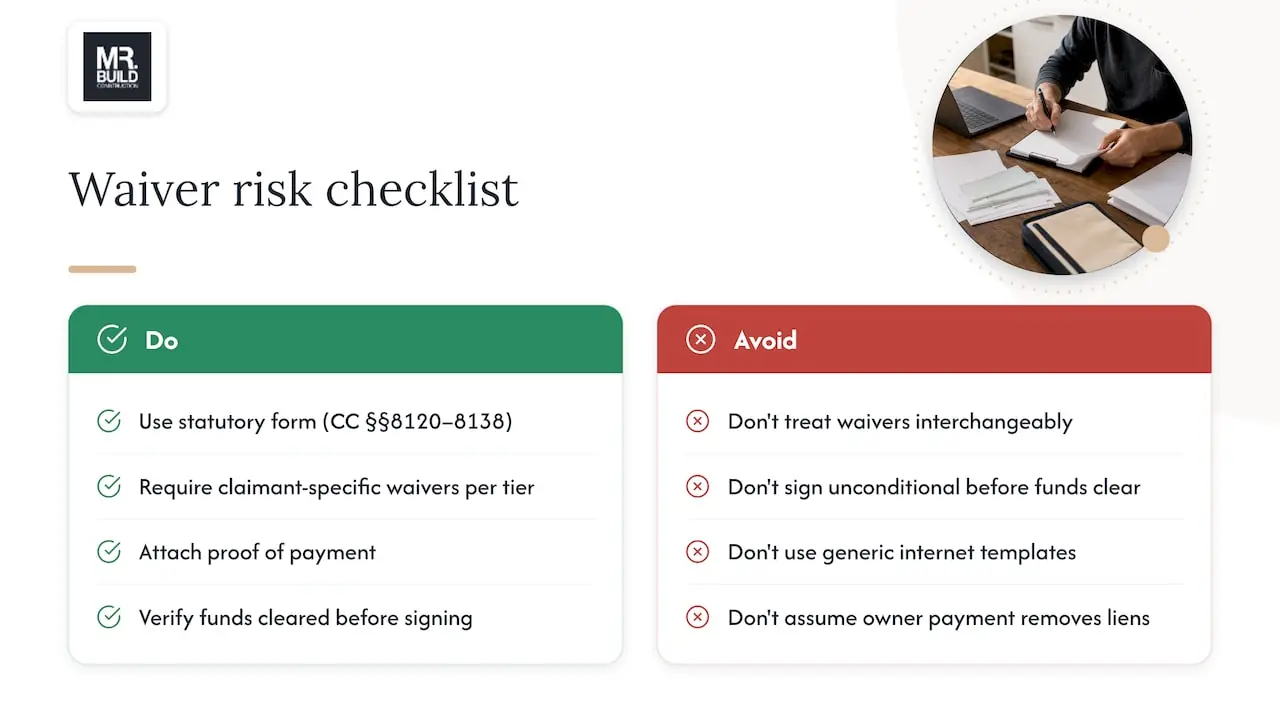
Keep a jobfile for every claimant that includes the front and back of cleared checks, the bank’s paid date, any joint check endorsements, and signed written acknowledgments where a check alone is not available. Avoid risky habits like asking a subcontractor to sign a waiver in blank before the payment amount is known, treating an un-cleared check as sufficient proof, or adding notarization that the statute does not require and that only slows down an already time-sensitive process.
Pro Tip: Attach a copy of the cleared check, front and back, directly to the waiver in your project file so the proof of payment travels with the document itself.
Preliminary notices and the deadlines that protect your claim
Before any waiver conversation starts, most subcontractors and suppliers on a California project are supposed to have sent a preliminary notice. This document tells the owner who is working on the project and preserves the sender’s right to file a lien later if they are not paid. Owners should track these notices carefully, because paying the general contractor does not guarantee that every subcontractor or supplier further down the chain actually got paid.
- Preliminary notices generally need to go out before work starts or within 20 days of starting work or delivering materials, according to CSLB’s homeowner guidance.
- A notice sent late does not void the claimant’s rights entirely, but it limits recovery to the 20 days before the notice was given and the period after.
- Once a mechanics lien is recorded, the claimant generally must start enforcement action within 90 days or the lien expires.
If a recorded lien shows up on a project you are managing and the 90 day window is approaching, that is the point to bring in a construction attorney rather than try to resolve it with paperwork alone.
A checklist for collecting, verifying, and filing waivers correctly
Good waiver administration is mostly about discipline at each payment event, not legal complexity. The steps below work for owners managing a single remodel and for contractors juggling several trades on one job.
- Build a claimant-by-claimant file at the start of the project and update it every time a payment goes out.
- Before accepting any unconditional waiver, confirm with your bank that the related check or transfer has actually cleared.
- Require subcontractors and suppliers to use the correct statutory form, never a modified version, and never sign a form that has been left blank.
- Tie every conditional waiver to a specific check number, amount, and through date, so there is no ambiguity about which payment it covers.
- Use joint checks on higher risk payments, naming both the subcontractor and the supplier who provided material, so both parties have to endorse the same check.
- Match the payee, the maker of the check, and the dollar amount exactly against the waiver before filing it.
- Reconcile outstanding preliminary notices before releasing any major draw, so you know who still has unresolved lien rights on the project.
Subcontractors and suppliers carry their own side of this responsibility. Never sign a waiver in blank, never accept verbal assurance that “the check is in the mail” as a reason to sign unconditionally, and always keep your own copy of the cleared check tied to the waiver you signed.
Pro Tip: Store waivers and their matching proof of payment in the same digital folder, named by claimant and date, so you can produce a complete record in minutes if a dispute ever surfaces.
Common pitfalls that create risk with lien waivers
The most frequent mistake is treating conditional and unconditional waivers as interchangeable paperwork rather than documents with different legal effects. Signing an unconditional waiver because “the check should clear in a day or two” is one of the fastest ways a subcontractor loses lien rights on money that never actually arrives.
Another common error is using a generic waiver template pulled from the internet instead of the statutory form. If the language does not substantially follow Civil Code §§8120 through 8138, the waiver may not hold up the way the signer expects, leaving both sides uncertain about what was actually released.
Owners sometimes assume that paying the general contractor in full protects them from all liens, when in fact unpaid subcontractors or suppliers further down the chain can still record a lien if they never received their share. Skipping claimant-specific waivers at each tier of the project is how that gap opens up.
Finally, sloppy recordkeeping undermines otherwise correct paperwork. A conditional waiver with no attached proof of payment, or a through date that does not match the actual billing period, creates exactly the kind of ambiguity that turns a routine payment into a dispute months later.
Challenging a waiver that was signed improperly or under pressure
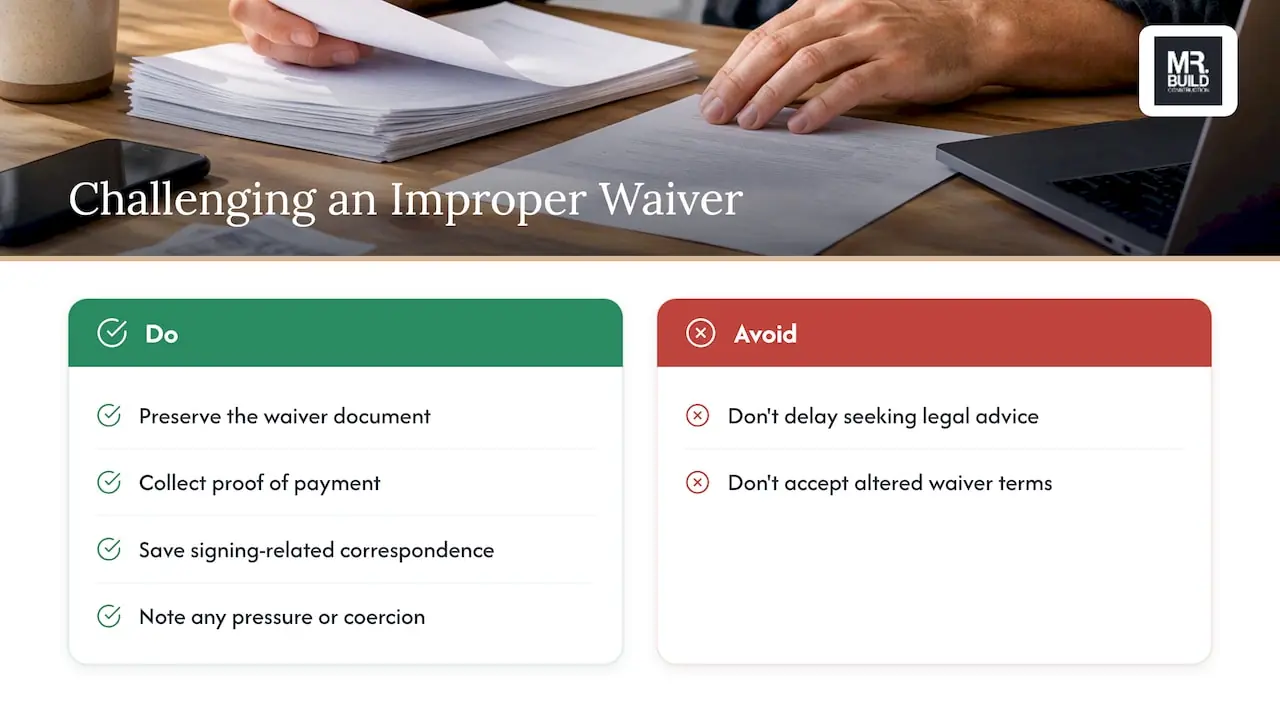
A lien waiver is not automatically bulletproof. If a waiver does not substantially follow the statutory form required by Civil Code §§8120 through 8138, it may be challenged on the basis that it never met the legal standard for a valid release in the first place.
Duress is another basis for a challenge, such as a subcontractor pressured to sign an unconditional waiver as a condition of receiving any payment at all, with no real opportunity to request the conditional form instead. Courts look at the circumstances surrounding the signature, not just the document itself.
A waiver signed in blank, then filled in later by someone other than the claimant, is also vulnerable to challenge, since the claimant never actually agreed to the specific terms that ended up on the page. The same applies to a waiver where the through date, payment amount, or payee information was altered after signing.
Anyone who believes they signed a waiver improperly should gather every related document immediately: the waiver itself, proof of what payment was actually made, correspondence around the signing, and any notes about pressure applied at the time. These disputes tend to turn on specific facts and timelines, which makes early legal advice far more useful than trying to resolve the issue informally after the fact.
How waivers interact with mechanic’s liens in California
A lien waiver and a mechanic’s lien sit on opposite ends of the same process. The lien is the legal claim a contractor, subcontractor, or supplier can record against a property when they have not been paid for work or materials. The waiver is the document that gives up the right to record that lien, tied to a specific payment.
Signing a waiver, especially an unconditional one, closes off the lien option for the payment it covers. That is precisely why the conditional form matters so much for anyone who has not yet confirmed that a check has cleared: signing unconditionally before payment arrives can mean losing lien rights on money that is never actually delivered.
Owners benefit from understanding this relationship because a project with properly collected waivers at every payment stage is far less likely to end up with a surprise lien recorded after the job is finished. A claimant who already signed an unconditional final waiver has, in most circumstances, given up the ability to record a lien tied to that contract, which is exactly the protection owners are collecting these forms to secure.
Why the stakes differ for subcontractors versus general contractors
A general contractor managing a California remodel usually has visibility into the overall payment schedule and can negotiate waiver terms directly with the owner. Subcontractors and suppliers further down the chain often have far less leverage and far more exposure, since they depend on the general contractor to actually pass along payment before their own lien rights lapse.
A supplier who delivers materials early in a project may be especially vulnerable if the general contractor gets paid by the owner but is slow distributing funds down the chain. That supplier’s only real protection is the preliminary notice they sent at the start of the job and the conditional waivers they insist on using at every draw.
General contractors, for their part, carry the administrative burden of collecting waivers from every subcontractor and supplier before passing their own waiver up to the owner. A general contractor who signs an unconditional waiver to the owner, without first confirming that every subcontractor below them was actually paid, can end up personally exposed if a sub later records a lien.
A typical payment and waiver timeline on a California remodel
A mid-size remodel project illustrates how these pieces fit together across a few months of work. Before the first day of work, subcontractors and major material suppliers send their preliminary notices, preserving lien rights from the outset.
At the first progress draw, perhaps after demolition and rough framing are complete, each subcontractor signs a conditional progress waiver tied to that specific payment. Once the checks clear a few days later, those same subcontractors provide the unconditional progress waiver confirming the funds actually arrived.
This pattern repeats at each major milestone, rough plumbing and electrical, drywall, finish work, with a fresh conditional waiver issued before payment and an unconditional one following confirmed clearance. At project closeout, the final payment triggers the same two-step process one last time: a conditional final waiver when the last check is issued, followed by the unconditional final waiver once that payment clears and the through date on the form matches the actual last day of work.
Throughout this cycle, the owner’s file grows claimant by claimant, with every waiver matched to its proof of payment, giving a complete record by the time the project wraps.
Recent developments worth watching in California lien law
California’s waiver and release framework in Civil Code §§8120 through 8138 has remained the controlling standard for the forms described throughout this guide, and the CSLB continues to publish the current statutory templates for conditional and unconditional releases. Anyone relying on an older waiver template should confirm it still matches the current CSLB forms before using it on a new project, since using an outdated or non-conforming version risks a waiver that does not hold up as intended.
Beyond the forms themselves, the broader rules around preliminary notices, lien recording, and the 90 day enforcement window described earlier remain the framework that owners and contractors need to track on every project. Because lien law can shift with new legislation or court decisions, anyone relying on a waiver for a high value payment, particularly a final payment closing out a large remodel, benefits from a quick check with a construction attorney or a review of the current CSLB publications before signing anything unconditional.
Mr Build Co. perspective: how we administer waivers on Los Angeles remodels
On remodeling and custom build projects, we track preliminary notices from subcontractors and suppliers as soon as they come in, and keep a claimant specific file that follows each trade from first draw to final payment. We do not release an unconditional waiver request until a payment has actually cleared, and use joint checks on higher value draws so both a subcontractor and their supplier have to endorse the same payment.
At closeout, we match every signed waiver against its cleared check before we consider a project financially complete. It is a process built on paperwork and follow through rather than shortcuts, and it is part of how we keep remodels organized from groundbreaking to final walkthrough.
— David S.
Working with a contractor who manages waivers correctly
Homeowners planning a kitchen remodel, a bathroom renovation, an ADU, or a full custom home in Los Angeles are often more focused on design decisions than paperwork, which is exactly where a disorganized payment process creates risk later. A contractor who treats waiver collection as a core part of project management, rather than an afterthought, gives you a cleaner paper trail if a subcontractor dispute ever surfaces after the work is done.
Mr Build Co. coordinates waiver collection, preliminary notice tracking, and payment verification as part of how we manage custom home, ADU and addition, and complete home remodeling projects across Los Angeles. If you are planning a remodel and want a contractor who keeps this part of the process organized alongside the design and construction work, reach out through Mrbuild to talk through your project.
FAQ
Are lien waivers required in California?
California law does not force every project to use lien waivers, but they are standard practice at nearly every payment stage because they give owners proof that a claimant’s lien rights have been addressed. Any waiver used must substantially follow the statutory forms set out in the Civil Code, not an informal substitute.
Which states require lien waivers to be notarized?
California does not require notarization for any of its four statutory waiver forms, and adding it is an unnecessary step rather than a legal requirement. Notarization rules vary by state, so contractors working outside California should confirm the requirement in that specific state rather than assuming California’s rules apply.
Which states have statutory lien waiver forms?
California is among the states that require waivers to substantially follow specific statutory language, with its four forms defined in Civil Code §§8120 through 8138. Other states set their own rules, so a form that works in California should never be assumed valid elsewhere without checking that state’s own statute.
What does California Civil Code Section 8138 say?
Civil Code §8138 sets out the statutory language for the unconditional waiver and release on final payment, the form used once the last payment on a contract has actually cleared. Like the other three statutory forms, it must be used in substantially the same wording the Legislature provided, and the CSLB publishes the current version as a downloadable form.
What’s the fastest way to check if a waiver form is still valid?
Compare the wording directly against the current version published by the CSLB, since the statutory language in Civil Code §§8120 through 8138 is what makes a waiver enforceable. If the form has been modified, shortened, or pulled from an outdated template, it may not hold up the way the signer expects.

