


For airtight, space-limited assemblies where vapor control matters, closed-cell spray foam is usually the better choice. For conventional framed cavities where a cost-effective, straightforward fill does the job, fiberglass or rock wool batts are typically fine. The real outcome depends less on the material than on installation quality and moisture management, which is why performance, code guidance, safety, and hybrid options all deserve a look before you decide.
TL;DR:
- Proper installation and moisture management are critical, as the effectiveness of batt insulation heavily depends on avoiding compression and voids.
- Hybrid wall assemblies with a layer of closed-cell spray foam against the sheathing can optimize air sealing and moisture control while reducing costs.
- Closed-cell spray foam provides a superior air barrier and vapor retarder at sufficient thickness, especially in cold climates, but requires careful vapor and drainage considerations.
- Conducting blower door tests and thermal scans after installation helps verify that whole-wall performance meets targets, rather than relying solely on labeled R-values.
- Choosing insulation must consider assembly type, air-sealing needs, moisture risks, and occupant sensitivities, with expert guidance recommended for complex or unusual conditions.
Table of Contents
- Spray foam vs batt insulation at a glance
- What closed-cell, open-cell, and batt insulation actually are
- How much insulation actually performs once it’s installed
- Moisture, vapor control, and code considerations for hybrid walls
- Installation risks and how to vet a spray foam applicator
- Flash-and-batt and other hybrid strategies worth considering
- A step-by-step way to decide for your project
- Our take on choosing insulation during a remodel
- How Mr Build Co. can help you get insulation right
- Sources
- FAQ
Spray foam vs batt insulation at a glance
Before getting into the details, here is how the two categories stack up on the factors that matter most for a remodel or new build.
- Closed-cell spray foam is rated around R-6 to R-7 per inch, while open-cell foam runs roughly R-3.5 to R-3.6 per inch, according to the Department of Energy’s guide to home insulation.
- Fiberglass and rock wool batts are typically rated between R-3 and R-4.3 per inch depending on density, per the same DOE guidance.
- Closed-cell spray foam functions as an air barrier at typical application thickness, while batts are air-permeable and do nothing to stop air movement on their own, as ICC installation guidance notes.
- Batts are commonly installed by homeowners or general contractors, while spray foam requires a trained, equipped applicator, since it involves pressurized two-component chemistry.
- Batts suit standard stud-bay walls and attic floors with regular framing; spray foam tends to earn its keep in rim joists, foundation walls, and tight or irregular cavities where an air seal matters most.
Homeowners weighing spray foam or fiberglass for a single project often find the decision comes down to the assembly type more than a blanket preference for one material.
What closed-cell, open-cell, and batt insulation actually are
Closed-cell spray polyurethane foam (ccSPF) is a rigid, dense foam with tightly packed cells that resist moisture and add structural stiffness. Open-cell spray foam (ocSPF) is softer and more flexible, with cells that stay open to air and moisture vapor. Fiberglass batts are pre-cut mats of spun glass fibers, while rock wool batts are made from mineral fibers, and both rely on trapped air pockets for their insulating value.
- Closed-cell foam rates around R-6 to R-7 per inch and expands modestly during application, filling gaps and adhering tightly to framing, per DOE.
- Open-cell foam rates around R-3.5 to R-3.6 per inch and expands significantly more, which makes it useful for filling irregular cavities without heavy weight or cost.
- Fiberglass and rock wool batts rate roughly R-3 to R-4.3 per inch, and both compress permanently if crammed into a cavity, cutting their effective performance.
- Batts fit best in standard, unobstructed stud bays and attic joist spaces, while both foam types handle odd shapes, penetrations, and tight rim joist cavities more reliably.
Cellulose vs spray foam insulation comparisons come up often too, and cellulose behaves more like a dense-pack batt alternative than a foam substitute, since it is also air-permeable and depends on installation density for performance.
How much insulation actually performs once it’s installed
The rated R-value on a product label describes lab conditions, not your wall. In the field, gaps around wiring, compressed batts, and small voids behind outlets let air bypass the insulation entirely, and ICC technical notes point to installation quality as the biggest factor separating a batt’s rated performance from what it actually delivers. Compression alone can meaningfully reduce a batt’s effective R-value, and a detailed breakdown of the mechanism shows how even small gaps create convective loops that carry heat around the insulation rather than through it.
Spray foam’s advantage in real-world performance comes less from its per-inch R-value and more from the air seal it creates. Because closed-cell foam bonds directly to framing and sheathing, it closes the air pathways that undermine batt performance, and Building America research on high-R-value wall assemblies emphasizes that whole-wall performance depends heavily on air sealing and framing fraction, not just cavity R-value alone.
If you want proof rather than a sales pitch, ask your contractor for verification. A blower door test measures whole-house air leakage before and after insulation work, giving you a number you can compare against a target. A thermal camera scan can reveal cold spots from compressed batts, missing insulation, or thermal bridging through framing members that a visual inspection would miss entirely.
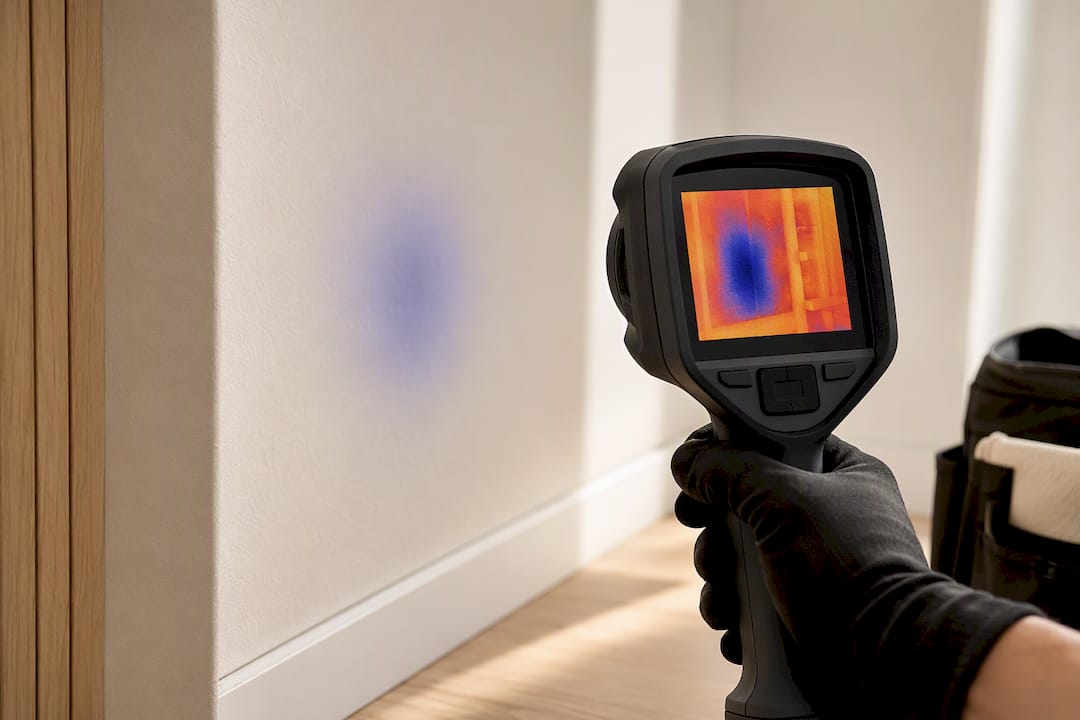
The larger lesson from building science is to think in terms of the whole assembly rather than cavity R-value in isolation. A wall with continuous exterior insulation and modest cavity fill can outperform a wall with a higher-rated cavity product installed poorly, which is exactly why framing fraction and air sealing deserve as much attention as the insulation label itself.
Moisture, vapor control, and code considerations for hybrid walls
Closed-cell spray foam at sufficient thickness acts as a vapor retarder, which changes how a wall assembly manages moisture and dries out over a season. ICC guidance documents this vapor-retarder behavior at specified thicknesses, and it matters because a wall that cannot dry to the interior needs a clear path to dry toward the exterior instead.
Hybrid assemblies, often called flash-and-batt, use a layer of closed-cell foam against the sheathing to control air and moisture, then fill the remaining cavity depth with batts. Building America guidance describes minimum foam thickness recommendations that vary by climate zone, since the ratio of foam to batt determines whether the assembly stays warm enough at the sheathing to avoid condensation. Getting that ratio wrong in a cold climate can trap moisture inside the wall rather than keep it out.
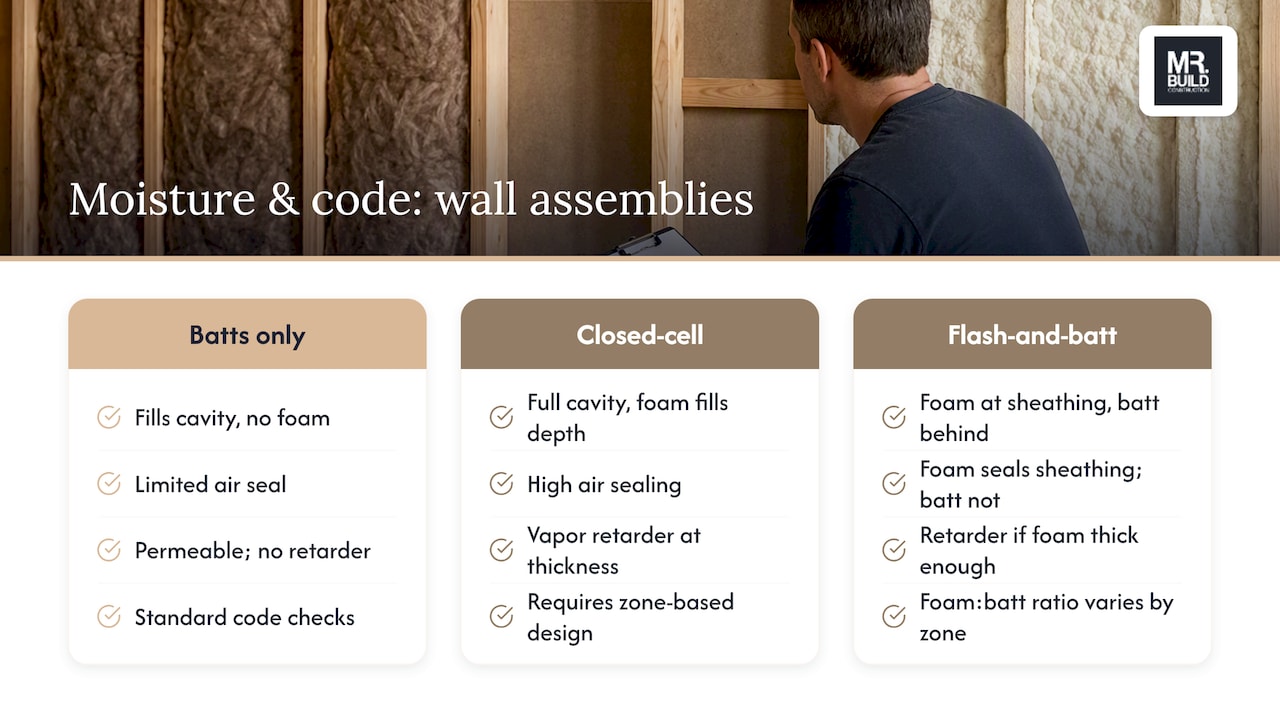
Open-cell foam is generally not appropriate for many below-grade applications, since it is vapor-permeable and can allow moisture from foundation walls to migrate into the assembly. Basements and below-grade walls typically call for closed-cell foam or a vapor-retarder strategy suited to the specific soil and drainage conditions.
The practical advice here is straightforward: check your local code before finalizing a hybrid ratio, avoid stacking two vapor barriers in the same assembly, and use a smart vapor retarder where the design calls for seasonal flexibility. When an assembly is unusual, a hygrothermal analysis from a building scientist is worth the conversation before construction begins.
Installation risks and how to vet a spray foam applicator
Spray foam installation carries real safety considerations that batt installation does not. The EPA’s guidance on chemical exposures from spray polyurethane foam explains that SPF application generates isocyanate vapors and aerosols, which means occupants need clear, written re-entry guidance, and work zones need to be isolated during application.
Beyond exposure risk, technique matters. EPA’s safer workplace practices call for applying foam in controlled lifts rather than one thick pass, since overly thick lifts can overheat during cure and lead to poor adhesion or lingering odors from improperly mixed chemistry. Ventilation that maintains negative pressure in the work area helps keep vapors from migrating into occupied parts of the home.
Before hiring an applicator, ask for the following:
- Training or certification records showing the applicator is qualified for two-component high-pressure SPF systems.
- Safety data sheets for the specific foam products being used on your project.
- A written re-entry time based on the product and expected site conditions, not a verbal estimate.
- A cleanup and ventilation plan for the day of application and the days following.
Pro Tip: Ask your contractor to schedule a blower door test after installation and to include remediation language in the contract in case initial results fall short of the target.
Flash-and-batt and other hybrid strategies worth considering
Flash-and-batt combines a thin layer of closed-cell spray foam, often one to two inches, against the sheathing with batt insulation filling the rest of the cavity. The foam layer handles air sealing and vapor control, while the batts add depth at a lower cost than filling the entire cavity with foam. Building America research notes this approach is common where budget or job constraints rule out full-depth foam but the project still needs the air-sealing benefit foam provides.
Hybrids tend to make the most sense in retrofit walls with mixed framing depths, rim joists where a small foam flash closes persistent leaks, and tricky details around windows or mechanical penetrations. Full-depth spray foam earns its cost in assemblies with limited cavity space, foundation walls needing continuous coverage, or any application where a design calls for the highest practical air seal in the smallest footprint.
Whatever ratio you land on, confirm it against manufacturer specifications and your local code office rather than a rule of thumb from a different climate zone.
A step-by-step way to decide for your project
Work through these criteria in order, since each one narrows the field before you get to a final call.
- Identify the assembly: rim joist, attic, foundation wall, and standard stud cavity each favor different materials based on shape and access.
- Assess air-sealing need: a leaky, drafty assembly benefits more from foam’s air barrier than from added batt depth alone.
- Evaluate moisture risk: below-grade and cold-climate assemblies need vapor strategy clarity before material selection, per Building America guidance.
- Consider occupant sensitivity and timeline: spray foam requires re-entry time and site isolation that batts do not.
- Weigh hybrid options where a full foam cavity is not justified by the assembly or the performance target.
- Require testing and documentation: a blower door test or thermal scan confirms whether the installed assembly meets the target, not just the label.
When an assembly involves unusual framing, mixed climates within one structure, or a history of moisture problems, bring in a building scientist for a hygrothermal calculation before committing to a strategy.
Our take on choosing insulation during a remodel
We look at insulation as one part of a coordinated assembly, not an isolated line item. A wall’s performance depends on framing, air sealing, moisture management, and the insulation working together, which is why we favor testing over assumptions whenever a project allows for it. Coordinating the insulation trade with framing and mechanical rough-in schedules avoids the compression and gap issues that undercut batt performance in the field. For homeowners who want one team managing that coordination from design through final inspection, that oversight is part of how we approach every remodel.
— David S.
How Mr Build Co. can help you get insulation right
Choosing between spray foam and batts is only part of the picture. The bigger factor is whether your framing, air sealing, and insulation trades are coordinated so the assembly performs the way it is designed to. A remodeling contractor brings integrated design and construction planning to remodels and new builds, coordinating applicators and framing crews so insulation decisions get made at the right point in the schedule rather than as an afterthought.

If your project involves a kitchen or bathroom remodel, an ADU, or a full complete home remodeling effort, our team can walk the assembly with you and recommend an approach suited to your specific walls and budget constraints. Schedule a consultation to get a site assessment before you finalize your insulation plan.
Sources
- Potential Chemical Exposures From Spray Polyurethane Foam | Safer Choice | US EPA
- Installation of Common Insulation Types | ICC
- Guide to home insulation | U.S. Department of Energy
FAQ
Why are people removing spray foam insulation?
Removal usually traces back to installation problems such as improper mixing, incorrect lift thickness, or application in conditions outside manufacturer specifications, which can cause lingering odors or poor cure. Following EPA safer workplace practices during installation significantly reduces this risk.
Why do insurance companies not like spray foam insulation?
Some insurers express caution around spray foam because improper installation can mask roof leaks or moisture problems behind rigid foam, delaying detection compared to a vapor-permeable material. This concern relates to installation quality and moisture management rather than the material itself being inherently risky.
Why is it hard to sell a house with spray foam insulation?
Buyers and their inspectors sometimes hesitate over spray foam because it can hide roof deck moisture issues or was installed without proper documentation of the product and process. Providing SDS records, installer certification, and any acceptance testing results from the original installation can address most buyer concerns.
Can I spray foam over batt insulation?
Spray foam is not typically applied directly over existing batt insulation in the same cavity, since the batts would need to be removed first for the foam to bond to the sheathing and framing. A more common approach is a flash-and-batt hybrid, where foam is applied first and new batts are added afterward in the remaining cavity depth, as described in Building America guidance.

