


Most complete Accessory Dwelling Unit submittals in Irvine move through initial plan check in about five business days, though the total calendar time to an issued permit runs longer once you factor in intake review, payment, and any correction cycles. The biggest variable is completeness: a package missing a discipline set, a fire-access answer, or a zoning confirmation can add weeks. The City of Irvine manages the entire process through its online portal, and firms like Mr Build Co. build their ADU workflow around avoiding those common holdups.
TL;DR:
- Submitting a complete ADU package, including discipline-separated drawings and supporting documents, reduces review delays and shortens the overall permit timeline.
- Using Irvine’s pre-approved ADU plans speeds up review if your lot has standard setbacks and soil conditions but offers limited time savings for complex site or fire-access issues.
- Verifying zoning rules and setback requirements early, especially for corner lots or special planning areas, prevents costly revision cycles and plan resubmittals.
- Addressing fire-related items such as sprinkler status and fire-access distances during initial preparation avoids additional review time and late-stage corrections.
- Coordinated design and permit management by contractors familiar with Irvine’s process help minimize resubmittals and streamline approval.
Table of Contents
- Permit timeline step by step: from prep to issuance
- How to use IrvineReady and interpret portal statuses
- When a pre-approved ADU plan speeds review, and its limits
- Zoning, setbacks, and local rules that commonly affect approvals
- Documents the City expects and early fire coordination items
- Frequent delays and clear steps to avoid them
- Quick reference: calendar ranges by project complexity
- Mr Build Co. perspective: how contractors reduce permit time
- How Mr Build Co. helps Irvine homeowners with ADU permits
- Sources
- FAQ
Permit timeline step by step: from prep to issuance
The City of Irvine’s ADU process follows a predictable sequence, and knowing each milestone helps you plan realistic calendar time rather than guessing.
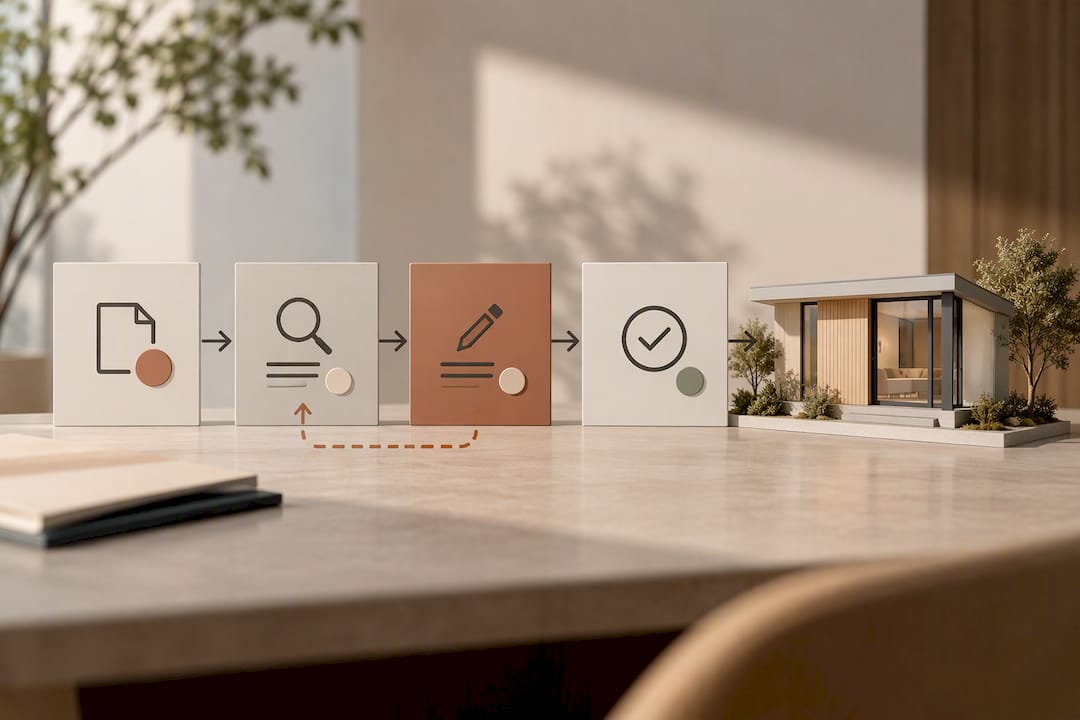
- Assemble a coordinated package. Your architect, structural engineer, and contractor should produce matching, discipline-separated drawings before anything goes online.
- Submit through the portal. Irvine requires electronic submission, and the file quality you upload determines how smoothly the next step goes.
- Completeness review. Staff generally checks the submittal for missing items in about two business days, and an incomplete package gets flagged with an Intake Hold rather than moving forward.
- Payment and acceptance. Once fees are paid and the package is accepted, the City assigns a plan-check number and a target review date.
- First plan check. The City’s stated target for a complete submittal is about five business days, though that figure assumes nothing is missing and no outside agency review is triggered.
- Corrections and resubmittal. Each round of corrections adds its own review cycle, so responding quickly and completely to comments matters more than the length of any single review window.
- Issuance. Once corrections clear, you pay any remaining fees and download your approved plan set to begin construction.
Homeowners who treat each step as sequential, rather than assuming the whole process runs on one clock, tend to plan construction schedules more accurately.
How to use IrvineReady and interpret portal statuses
IrvineReady is the City’s online submission platform, and it works best in Chrome with discipline-separated, readable PDF files uploaded before you click the green Submit button, which is the final action in the process.
Portal statuses tell you exactly where your application sits:
- Pending means your files have arrived but have not yet been reviewed for completeness.
- Intake Hold, pending files means something is missing or unreadable and needs your attention before staff can proceed.
- Intake Hold, Payment Pending means your package passed completeness review and is waiting on your fee payment.
- Accepted means payment cleared and a plan-check number with a target date has been assigned, according to the IrvineReady user manual.
Pro Tip: Open every PDF yourself before submitting, since a file that looks fine on your desktop can still trigger an Intake Hold if it is encrypted, password protected, or improperly merged.
When a pre-approved ADU plan speeds review, and its limits
Irvine’s Pre-Approved ADU Plans Program offers architectural and structural plans that have already cleared design review, which removes a substantial chunk of the engineering back-and-forth from your timeline. You still submit the chosen plan with your building permit application, and the City performs a site-specific review for zoning and foundation conditions on your particular lot.
- A pre-approved plan fits well when your lot has standard setbacks, typical soil, and no unusual grading.
- It may need minor modifications if your foundation conditions or site geometry differ from the plan’s assumptions.
- It won’t save meaningful time if your property sits in an overlay area or has fire-access complications that require separate review regardless of which plan set you use.
Zoning, setbacks, and local rules that commonly affect approvals
Zoning compliance is where many ADU applications lose time, so verifying your parcel’s rules before you submit is worth the effort.
- Standard single-family lots commonly show setback figures like a 15-foot front, 5-foot side, and 10-foot rear yard, though exceptions apply by lot type and location.
- Corner lots, and special planning areas such as Shady Canyon, often carry different setback and design standards than a typical interior lot.
- Lot coverage and height limits get checked against your ADU’s footprint and roofline, and parking or landscaping standards can trigger additional review if your site is tight.
- Confirming your parcel’s zoning and planning-area rules at the Planning Counter before filing catches conflicts while they’re still cheap to fix on paper.
Documents the City expects and early fire coordination items
A complete Irvine ADU submittal generally includes a defined set of documents, and gathering them early prevents the kind of mid-review scramble that stalls a plan check.
- Architectural drawings showing floor plans, elevations, and site layout.
- Structural calculations supporting the framing and foundation design.
- A site plan confirming setbacks, lot coverage, and existing structures.
- A plan submittal criteria form that flags fire-related conditions, including whether the primary home is sprinklered and whether the ADU sits more than 140 feet from a fire-access roadway, either of which can trigger Orange County Fire Authority review before permits issue.
- Geotechnical or foundation reports, commonly requested when soil conditions or grading depart from standard assumptions, including for some pre-approved plan sites with atypical foundation needs.
Frequent delays and clear steps to avoid them
A handful of habits separate the ADU projects that move quickly from the ones that stall.
- Upload discipline-separated, readable, unencrypted PDFs the first time, since file problems are a leading cause of Intake Hold status.
- Confirm zoning, overlay, and setback rules before filing rather than after a plan checker sends corrections.
- Flag sprinkler status and fire-access distance early so any required OCFA input happens in parallel with plan check, not after it.
- Use a pre-approved plan when your site qualifies, and coordinate your architect, engineer, and contractor so the first submittal is genuinely complete.
Pro Tip: Ask your contractor to review the full package against the City’s plan submittal criteria form before it ever reaches the portal.
Quick reference: calendar ranges by project complexity
These bands reflect how completeness and project type shape your realistic calendar time, not a guarantee for any specific project.
- A simple, pre-approved-plan ADU with a fully complete first submittal tracks closest to the City’s stated review targets.
- A standard custom ADU with one or two minor correction rounds adds proportional time for each resubmittal cycle.
- A complex project needing OCFA coordination, geotechnical review, or multiple correction cycles takes noticeably longer, since each outside review and each resubmittal restarts part of the clock.
Corrections are the single biggest multiplier here: a clean first submittal is worth more than any other single decision you make.
Mr Build Co. perspective: how contractors reduce permit time
Integrated design and permit coordination, where the architect, structural engineer, and contractor work from one shared package, cuts down on the Intake Holds and resubmittal cycles that stretch an ADU timeline. Some contractors specialize in ADUs and coordinate design, permits, and construction under one roof. When hiring a contractor to manage your permit process, ask who reviews the file package before submission, who responds to City corrections, and who tracks portal status day to day.
— David S.
How Mr Build Co. helps Irvine homeowners with ADU permits
An ADU permit moves fastest when one team owns the design, the paperwork, and the construction plan from the start, and that coordination is what can be built into every ADU project.

- Integrated design and construction planning that keeps your submittal package consistent across every discipline.
- Local permitting experience specific to Irvine’s process, portal, and plan-check expectations.
- Clear communication throughout design, permitting, and construction so you always know where your project stands.
If you’re planning an ADU in Irvine, visit our ADU / Additions page to see how we approach design and permit coordination, or reach out through Mrbuild to request a consultation.
Sources
- Project: Constructing accessory dwelling unit (ADU) | City of Irvine
- Plan Submittal Criteria Form | City of Irvine (legacy)
FAQ
How long does it take to get an ADU permit in Los Angeles?
Timelines vary by jurisdiction within Los Angeles County, and Irvine’s own process is a useful local benchmark: complete submittals typically move through initial plan check in about five business days, though total calendar time depends heavily on completeness and correction cycles. Homeowners outside Irvine should check their specific city’s building department for its own published targets.
What happens if you build an ADU without a permit in California?
Building without a permit exposes you to stop-work orders, fines, and difficulty selling or refinancing the property later, since unpermitted work generally has to be disclosed. It can also mean tearing out completed work to bring it up to code during a later inspection.
How fast can I build an ADU?
Construction time depends on your ADU’s size and complexity, but the permit process itself is often the longer variable, especially for a project needing corrections or outside agency review. A complete, coordinated submittal through Irvine’s IrvineReady portal is the most reliable way to keep the front end of your project on schedule.
What triggers extra fire agency review for an Irvine ADU?
Irvine’s plan submittal criteria flag conditions such as whether the primary home is already sprinklered and whether the ADU sits more than 140 feet from a fire-access roadway, either of which can require Orange County Fire Authority approval before permits issue. Flagging these items during plan preparation, rather than during plan check, avoids a late-stage resubmittal.
Can I speed up my Irvine ADU permit by using a pre-approved plan?
Choosing a plan from Irvine’s Pre-Approved ADU Plans Program removes much of the design review from your timeline, since the architectural and structural plans are already cleared. The City still performs a site-specific review for zoning and foundation conditions, so it helps most on standard lots without unusual site constraints.

