


Design-build is a single-contract delivery method that unites design and construction under one team, with one point of accountability from concept through completion. Instead of hiring an architect and then bidding the finished drawings to a separate contractor, you hire one entity to do both. The typical outcome, backed by FHWA research, is a shorter overall schedule and fewer costly change orders late in construction.
TL;DR:
- Design-build projects typically deliver faster completion times and fewer late change orders compared to traditional methods, especially with experienced teams.
- The process involves continuous collaboration between design and construction, with early phases focused on cost modeling, sequencing, and detailed design development.
- Owners should verify the team’s experience with similar projects, staffing stability, clear risk allocation, and structured communication plans before contracting.
- Risks related to design errors and buildability are mostly transferred to the design-builder, but fair contract language is essential to prevent defensive pricing and corner-cutting.
- Design-build is most suitable for projects where speed, tight coordination, and complexity are critical, while new owners and rushed timelines may face challenges without proper experience.
Table of Contents
- How Does the Design-Build Process Differ From Design-Bid-Build?
- What Are the Phases of the Design-Build Process?
- Who Is Responsible for What in a Design-Build Project?
- What Does the Research Say About Design-Build Performance?
- Is Design-Build Right for Every Project?
- How Should Owners Vet a Design-Build Team?
- What Does Design-Build Look Like on a Residential Project?
- What Owners Get Wrong About Design-Build
- How Mrbuild Delivers Design-Build for Los Angeles Homeowners
- Where to Read More on Design-Build Standards
- Sources
- FAQ
How Does the Design-Build Process Differ From Design-Bid-Build?
In traditional design-bid-build, you hire a designer to complete drawings, then send those drawings out for competitive bids, then sign a separate contract with whichever contractor wins. Three contracts, three relationships, and three points where miscommunication can creep in. Construction manager at risk (CMR) narrows that gap by bringing a contractor on board during design, but the contractor and designer still answer to you separately, under separate agreements.
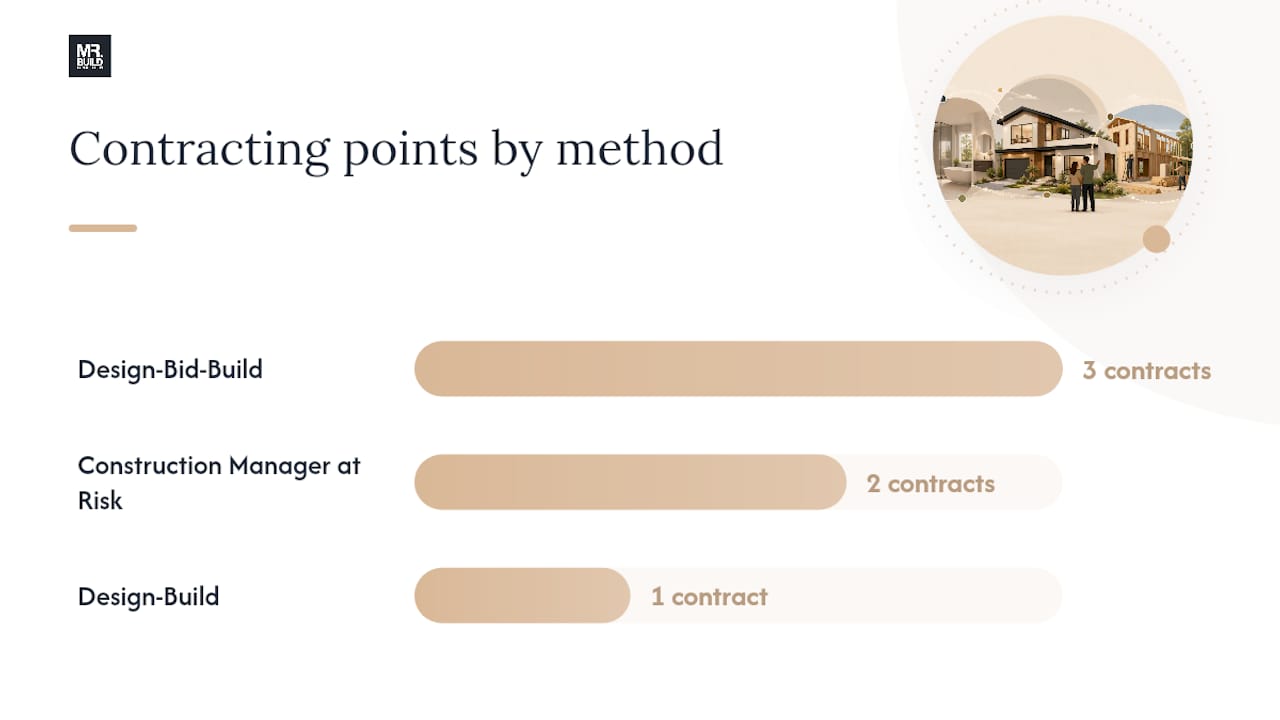
Design-build collapses all of that into one contract with one accountable party. The design-builder warrants that its documents will be complete and free from error, and because only one procurement process is needed instead of two, the overall timeline often compresses. That single point of responsibility is the defining feature. If something goes wrong, you are not left refereeing a dispute between your architect and your contractor over whose design or whose execution caused the problem.
Owners typically select a design-builder through one of a few approaches:
- Qualifications-based selection, where past project experience and team credentials carry the most weight.
- Best-value selection, which weighs qualifications alongside price or technical proposals.
- Two-step selection, which shortlists qualified firms first, then requests detailed proposals from that smaller group.
What Are the Phases of the Design-Build Process?
Every design-build project moves through a recognizable sequence, even though the pace and formality shift depending on project size and complexity.
- Discovery and alignment. You and the design-builder establish goals, site constraints, and an early budget framework. This is where realistic expectations get set. Vague goals at this stage tend to produce disappointment later, so specificity matters more than speed.
- Team selection and contracting. You finalize the design-builder relationship and choose a contract structure, whether that is a guaranteed maximum price, lump sum, or a progressive approach that defers firm pricing until scope firms up.
- Concept and schematic design. The design team develops initial layouts and massing while the construction side provides running cost feedback. This continuous loop, builder input paired with design decisions, is what catches budget mismatches before they become expensive surprises.
- Design development and preconstruction. Drawings get more detailed, and the team starts sequencing work and identifying long-lead materials that need to be ordered early to avoid schedule delays later.
- Construction. Building happens with the design team still engaged, so field questions get resolved quickly instead of stalling for a formal request-for-information cycle.
- Closeout and turnover. You receive warranties, operation manuals, and as-built documentation, and the team walks you through commissioning before handing over the keys.
Pro Tip: Ask your design-builder to show you the cost model at the end of schematic design, not just at contract signing. If the numbers have not moved since the initial budget conversation, that is a sign the team is doing real cost tracking rather than guessing.
The through-line across every phase is that design and construction decisions inform each other continuously, rather than happening in sequence with a wall between them.
Who Is Responsible for What in a Design-Build Project?
The design-builder holds primary responsibility for both design and construction outcomes, but that does not mean you disappear from the process. You still approve design milestones, budget updates, and material selections at defined checkpoints.
Some design-build firms keep design professionals in-house. Others partner with independent architects and engineers under the design-builder’s contract, which still preserves single-point accountability to you even though the design work is subcontracted.
Contract structures you are likely to encounter include:
- Guaranteed maximum price (GMP): the design-builder commits to a cost ceiling once design is sufficiently developed.
- Lump-sum: a fixed price agreed upon before construction starts, usually once scope is well-defined.
- Cost-plus-to-GMP: actual costs are tracked and billed, capped by a maximum price.
- Progressive design-build: the design-builder is engaged early under a preliminary agreement, with firm pricing negotiated once design and scope are validated, an approach DBIA identifies as an effective way to capture early collaboration while deferring price risk.
Risk transfer in design-build shifts much of the design error and buildability risk to the design-builder, which simplifies your oversight burden. That transfer only protects you if the contract language allocates risk fairly. A contract that pushes every contingency onto the design-builder without reasonable terms tends to produce defensive pricing or corner-cutting, not better outcomes.
What Does the Research Say About Design-Build Performance?
Design-build’s reputation for speed is not just marketing. Regression analyses from the CII/Pankow research summarized by WSDOT found design-build projects delivered faster and experienced lower schedule growth than design-bid-build or CMR projects, with comparable unit costs across the data set.
The performance gap narrows considerably when the owner or the project team lacks prior experience with design-build. The same research ties the strongest outcomes to relational project culture, repeated team relationships, and active owner engagement during design decisions, not just the contract type itself.
That caveat matters. Design-build is a framework, not a guarantee. A first-time owner paired with a design-build team that has never worked together will not automatically see the schedule and cost benefits the data shows for experienced teams. The FHWA effectiveness study similarly found procurement time savings tend to be most pronounced when the selection process itself is well structured, not rushed.
Is Design-Build Right for Every Project?
Design-build tends to perform best on projects where speed matters, where mechanical, electrical, and structural systems need tight coordination, or where the scope is complex enough that back-and-forth between separate designers and builders would otherwise slow things down. A custom home with an intricate structural layout, a full gut renovation with new mechanical routing, or an ADU squeezed into a tight lot all fit this profile well.
Design-build is less appropriate when:
- Public procurement rules require strict separation between design and construction contracts.
- You specifically want an independent design advocate checking the builder’s work throughout construction.
- Your project team has no prior design-build experience and the schedule leaves no room for a learning curve.
Owner experience and how carefully the delivery method is chosen matter as much as the contract type itself. A design-build approach handed to an inexperienced team on a rushed timeline rarely outperforms a well-run design-bid-build project.
How Should Owners Vet a Design-Build Team?
Getting the benefits of design-build starts before you sign anything, during selection.
- Ask for examples of projects similar in scope and complexity to yours, not just impressive but unrelated work.
- Ask who specifically will staff your project and whether that team stays through closeout, since turnover mid-project erodes both schedule and quality.
- Confirm insurance coverage and any performance guarantees appropriate to your project size.
- Require a written risk allocation summary before signing, so you understand who bears responsibility for design errors, delays, and cost overruns.
- Set a communication cadence in writing, whether that is weekly check-ins or milestone-based reviews, so updates are not left informal.
Red flags include vague milestone definitions, reluctance to name specific team members, and risk allocation that reads as one-sided in the contractor’s favor. DBIA’s best-practice guidance recommends structured partnering and measurable performance expectations built into the agreement itself, not left as a verbal understanding.
Pro Tip: Insist on a named core-team commitment in the contract, not just a firm’s name. Staffing continuity guarantees are one of the simplest ways to protect your schedule from turnover-related setbacks.
If you are also managing trade coordination, the same discipline applies to specialty contractors. Questions worth asking painters, tile setters, and other finish trades before you hire follow a similar due-diligence pattern to what you should demand from your design-builder.
What Does Design-Build Look Like on a Residential Project?
Residential design-build follows the same core logic as commercial projects, just at a smaller scale and with more personal stakes. Mrbuild works across custom home construction, ADUs and home additions, whole-home remodeling, and demolition and rebuild projects throughout Los Angeles, all under an integrated design-build structure.
On a residential job, early collaboration between design and construction teams typically covers:
- Cost modeling during concept design, so you see realistic numbers before finishes and layouts are locked in.
- Sequencing decisions for permitting, demolition, and long-lead materials like custom cabinetry or specialty windows.
- Continuous design input during construction, so field discoveries, like an unexpected structural condition behind a wall, get resolved without stalling the whole project.
What you should expect at handover: complete as-built drawings, appliance and material warranties, and a walkthrough of anything requiring ongoing maintenance. Residential design-build firms generally report that integrated design and construction reduces the small execution gaps that otherwise trigger field changes and delays.
What Owners Get Wrong About Design-Build
The biggest misconception is that design-build guarantees a smooth project just because one company holds both roles. It does not. Success still depends on the specific team, their communication habits, and whether milestones are clearly defined in the contract, not on the delivery method alone.
Owners who do best set expectations early, demand a staffing plan in writing, and insist on defined checkpoints rather than vague timelines. On one project a homeowner assumed “faster” meant “less involved,” and the schedule slipped precisely because no one asked her to approve material selections until it was almost too late. Design-build rewards owners who stay engaged, not owners who step back.
— David S.
How Mrbuild Delivers Design-Build for Los Angeles Homeowners
If you have been reading this while thinking about your own kitchen overhaul, ADU, or full rebuild, here is what that looks like in practice. Design and construction are managed under one roof for homeowners in various communities, handling custom home builds, ADUs and additions, whole-home remodeling, kitchen and bathroom renovations, and demolition and rebuild projects.
What sets an integrated approach apart is the discovery phase itself. Before drawings advance far, Mrbuild’s team walks the site, discusses your goals, and builds a realistic project framework so your design decisions and construction sequencing stay aligned from day one. That early coordination is exactly what the phase-by-phase process above is built around: fewer surprises, clearer accountability, and a team that answers to you instead of pointing fingers at each other.
If you are planning a custom home or considering an ADU or addition, the next step is a discovery conversation with Mrbuild’s team to talk through your site, your goals, and what a realistic project timeline looks like for your property.
Where to Read More on Design-Build Standards
For deeper research, the DBIA best-practices primer covers validation and risk allocation in detail, and FHWA’s design-build effectiveness study walks through procurement methods and documented time savings.
Sources
- Design-Build Effectiveness Study – Design-Build Project Delivery — FHWA
- Revisiting project delivery system performance: CII/Pankow 2018 report (WSDOT summary)
- Design-Build best practices primer — DBIA (NW primer PDF)
- Benefits of a design-build contract in commercial construction — Cobb Cole
FAQ
What Is the Difference Between Design-Build and Design-Bid-Build?
Design-build uses one contract with one accountable team for both design and construction, while design-bid-build uses separate contracts for the architect and the contractor, typically with a competitive bid process between design completion and construction.
How Long Does the Design-Build Process Take?
Timelines vary by project scope, but research shows design-build projects experience faster overall delivery and lower schedule growth compared to design-bid-build, largely because procurement and design phases overlap instead of running sequentially.
Does Design-Build Cost More Than Traditional Delivery?
Cost outcomes depend heavily on the specific project and team, and research indicates unit costs are generally comparable between design-build and traditional delivery methods, with the main advantage showing up in reduced schedule growth and fewer late change orders.
Can Design-Build Work for a Home Remodel or ADU?
Yes. Mrbuild applies design-build principles to residential projects including kitchen remodeling, whole-home renovations, and ADU construction, coordinating design and construction decisions under one team throughout the project.
What Should I Ask Before Hiring a Design-Build Team?
Ask about experience with similar projects, who will staff the job through completion, how risk is allocated in the contract, and what communication cadence you can expect once construction begins.

