


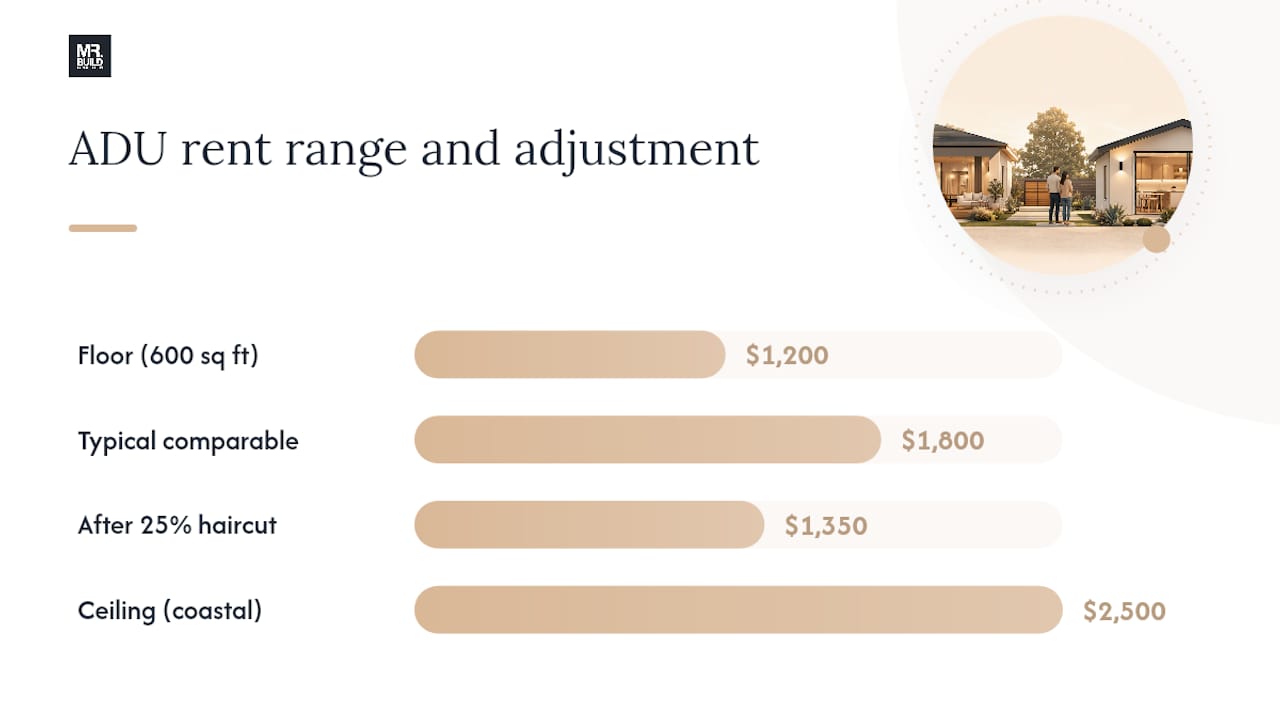
A typical one-bedroom ADU rents near the national midpoint of roughly $1,200 to $2,500 a month, depending heavily on your market. Lenders will generally cap the ADU income counted toward mortgage qualification at about 30% of your effective income, and less if you have no rental history yet. The sections below walk through the rent math, lender documentation, taxes, and permitting rules that turn that range into a concrete number for your property.
TL;DR:
- Lenders typically cap rental income from ADUs at 30% of your total effective income, limiting its impact on mortgage qualification regardless of actual rent.
- Neighborhood demand, finish level, and unit layout significantly influence the achievable rent, which varies by local factors more than city-wide averages.
- Proper documentation, including lease agreements and rent estimates, is essential for lenders to consider ADU income, especially without prior rental history.
- ADU rental income is taxable on Schedule E, but deductible expenses such as mortgage interest, property taxes, and depreciation can reduce taxable income.
- Designing an ADU with private entries, separate utilities, and durable finishes optimizes rental potential and tenant retention over the long term.
Table of Contents
- How Much Can an ADU Rental Property Earn?
- Using ADU Rental Income to Qualify for a Mortgage
- How Is ADU Rental Income Taxed and Reported?
- Calculating Net ADU Income and Payback Period
- Long-Term, Mid-Term, or Short-Term: Which Rental Model Fits?
- Screening Tenants and Writing ADU-Specific Lease Terms
- Permits, Zoning, and Short-Term Rental Rules to Check First
- Building an ADU That Actually Rents Well
- What Actually Moves the Needle on ADU Income
- Build an ADU Designed to Perform as a Rental
- Where to Verify the Rules Before You Commit
- Sources
How Much Can an ADU Rental Property Earn?
The honest answer is: it depends more on your block than your city. Two ADUs of identical size, three miles apart, can rent $400 apart because one sits near a transit stop or major employer and the other doesn’t. Neighborhood comparables affect achievable rent more significantly than city-wide averages, which is why pulling three to five local listings for a similar unit beats trusting any national figure.
That said, national data gives you a starting point. Market research from BuildWithAPlan’s city-by-city analysis puts most 600-square-foot, one-bedroom ADUs between $1,200 and $2,500 a month, with coastal high-cost markets running well above that ceiling. A studio conversion in a lower-cost inland market might land near the floor. A detached, private-entry unit in a coastal job center can clear the top of that range without much trouble.
Three factors influence the rent variations:
- Neighborhood demand. Proximity to transit, hospitals, universities, or major employers consistently pushes rent higher than unit quality alone.
- Finish level. Stone countertops and a separate HVAC zone justify a higher ask than a converted garage with a window unit.
- Unit size and layout. A true one-bedroom with a defined bedroom door commands more than an open studio, even at the same square footage.
Quick math: if comparable rents in your area run $1,800 a month, don’t plug $1,800 straight into your projections. Lenders and appraisers apply a vacancy and collection-loss adjustment, often 25% under Fannie Mae’s guidance, before counting that income toward qualifying.
Short-term rental listings often advertise nightly rates that annualize to more than a long-term lease would produce, but this premium comes with real costs such as local permitting challenges, higher liability exposure, and more active management compared to long-term tenants. Treat the STR number as a ceiling, not a planning baseline, until you’ve confirmed your city allows it on an accessory unit at all.
Using ADU Rental Income to Qualify for a Mortgage
If you’re financing the ADU build itself, or refinancing a property that already has one, the rent you’ll eventually collect can help you qualify, but only under specific rules. This is where most homeowners get surprised.
The core rule: Fannie Mae’s selling guide caps the ADU rental income used in your qualifying calculation at 30% of your total monthly effective income. Freddie Mac applies a comparable standard, and HUD’s Mortgagee Letter extends similar treatment to FHA-backed loans. That 30% ceiling exists regardless of how much rent you actually expect to collect, so a $2,000-a-month ADU won’t necessarily move your qualifying income by the full $2,000.
If you have no rental history on the unit yet, because it’s new construction or you’ve never leased it, HUD’s guidance allows lenders to use only 75% (or in some cases 50%) of the lesser of the appraiser’s estimated rent or the lease amount, when history is unavailable. Once you have a signed lease and a track record, underwriters give more weight to actual performance.
Lenders will typically ask for:
- A signed lease or lease agreement for the ADU unit.
- An appraiser’s Single Family Comparable Rent Schedule, Form 1007, estimating fair market rent.
- Schedule E from a prior tax return if the unit has rental history.
- Proof of security deposit and first month’s rent, or bank statements showing deposits.
The exact math varies by lender, so ask your loan officer to run the numbers against your specific file before you count on a figure.
How Is ADU Rental Income Taxed and Reported?
ADU rental income is generally taxable and gets reported on Schedule E of your federal return, the same form used for any residential rental property, unless your situation rises to the level of a separate business activity. Most homeowners renting a single ADU on their own lot stay squarely in Schedule E territory.
The upside is that a real list of expenses reduces your taxable rental income:
- Mortgage interest allocated to the ADU’s share of the property.
- Property taxes, prorated by square footage or a reasonable method.
- Insurance premiums for the rental portion of the property.
- Repairs, maintenance, and utilities you pay on the tenant’s behalf.
- Depreciation on the ADU structure itself, calculated separately from the main house.
When an expense covers the whole property, like a new roof or shared water bill, you’ll allocate it based on square footage or another consistent, defensible method. Pick one allocation approach and stick with it year over year rather than switching methods to chase a bigger deduction.
Pro Tip: Keep a dedicated folder, digital or physical, for every ADU-related receipt, lease, and bank deposit. The same documentation that supports your Schedule E deductions is often the exact paperwork a lender will ask for if you refinance later.
Good records protect you twice: once at tax time, and again if you ever need to prove rental history to a future underwriter.
Calculating Net ADU Income and Payback Period
Gross rent numbers make for good headlines, but net cash flow is what actually pays your mortgage. Here’s a sequence you can run against your own property.
- Start with your realistic gross monthly rent, based on local comparables rather than a national average.
- Subtract a vacancy reserve, typically 5% to 10% of gross rent, to account for tenant turnover and gaps between leases.
- Subtract fixed monthly costs: property tax allocation, insurance, and any HOA-related fees tied to the ADU.
- Subtract variable costs: utilities you cover, routine maintenance, and a repair reserve (often 5% of gross rent).
- What remains is your net monthly cash flow before financing costs.
- Divide annual net cash flow by your total ADU construction cost to get a simple cash-on-cash return.
- Divide construction cost by annual net cash flow to estimate a simple payback period in years.
| Input | Example figure |
|---|---|
| Gross monthly rent | $1,800 |
| Vacancy reserve (a portion of gross rent) | ‑$133 |
| Insurance & tax allocation | ‑$150 |
| Utilities & maintenance reserve | ‑$180 |
| Net monthly cash flow | $1,350 |
| Annual net cash flow | $16,200 |
| Estimated construction cost | $150,000 |
| Simple payback period | approximately 11 years |
Your own construction cost, comparable rents, and vacancy assumption will move this table substantially, so treat the figures as a template rather than a promise. FHFA research on ADU appraised values also suggests properties with ADUs can carry higher appraised value in some markets, which adds an equity dimension to the payback math beyond monthly cash flow.
Long-Term, Mid-Term, or Short-Term: Which Rental Model Fits?
The rental structure you choose changes your revenue ceiling and your workload just as much as location does.
- Long-term leases (12 months or more) produce the most predictable income and the least hands-on management, which is exactly what most mortgage underwriting expects to see documented.
- Mid-term rentals (one to six months) often suit homeowners near hospitals, universities, or corporate relocation hubs, and can command a premium over standard long-term rent without the licensing headaches of a nightly rental.
- Short-term rentals can produce the highest gross revenue on paper, but they demand active management, carry higher insurance and liability exposure, and are frequently restricted or banned outright for accessory units.
Before committing to any model, check your city’s regulations on short-term rentals and any owner-occupancy requirement tied to your ADU permit. Some jurisdictions allow STR use only if the owner lives on-site; others ban it for ADUs entirely regardless of owner occupancy. If you do pursue mid-term or short-term rentals, budget for furnishing costs, a landlord-friendly insurance policy that covers short-stay guests, and any local business license the rental requires.
Screening Tenants and Writing ADU-Specific Lease Terms
An ADU sharing a lot with your primary residence creates logistics a standalone rental never has to address. Screening should include pay stubs or income verification, a credit report, and references from a prior landlord, the same baseline Freddie Mac’s management guidance recommends for any rental unit.
Your lease addendum should spell out:
- Parking assignments and any restriction on guest vehicles.
- Utility allocation, especially if the ADU shares a meter with the main house.
- Access to shared yard space, driveways, or storage areas.
- Quiet hours and noise expectations given the close proximity to your own home.
Pro Tip: Do a joint move-in walkthrough with the tenant and photograph shared spaces, not just the unit interior. Disputes over driveway access or yard use are far easier to resolve when both parties agreed to the terms in writing on day one.
Permits, Zoning, and Short-Term Rental Rules to Check First
Rental income potential means nothing if your ADU isn’t legally permitted to be rented the way you’re planning. Zoning and rental rules are set locally, not federally, so a strategy that works two towns over may not be legal where you live.
Before finalizing your income strategy, verify:
- Whether your city requires owner-occupancy of the main house as a condition of renting the ADU.
- Whether short-term rentals are permitted, restricted, or banned for accessory units, as seen in municipal ADU guidance like San Diego’s.
- Whether your ADU falls under a deed-restricted, income-limited program, similar to the AMI-based eligibility rules some counties attach to ADU incentive programs.
- Whether your HOA, if you have one, imposes its own rental restrictions beyond city zoning.
Check your municipal planning department’s ADU program page directly rather than relying on a neighbor’s account of the rules; ordinances change, and a permit issued three years ago may not reflect current restrictions.
Building an ADU That Actually Rents Well
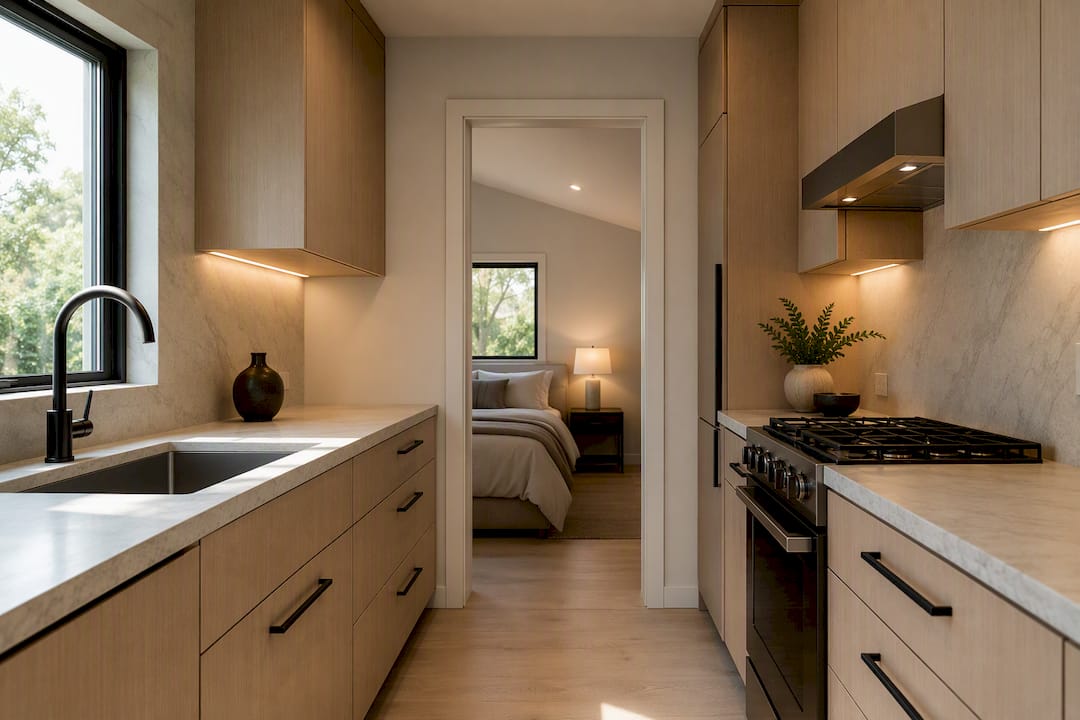
Design choices made before groundbreaking determine your rent ceiling for decades. A private entry separate from the main house consistently commands higher rent and attracts longer-staying tenants than a unit requiring shared access. Separate utility metering, where the lot allows it, removes a common source of tenant disputes and simplifies your Schedule E allocation. Sound insulation between the ADU and the main house, and efficient galley-style kitchens that maximize usable counter space in a small footprint, both show up in what tenants are willing to pay.
Mrbuild’s ADU construction projects consistently prioritize these details because they affect leasing outcomes long after the final walkthrough. Durable flooring, quality cabinetry, and a defined bedroom with a door, rather than an open loft, remain the layout features that keep long-term tenants in place year after year.
What Actually Moves the Needle on ADU Income
Most ADU content treats the rent estimate as the hard part and glosses over the underwriting math, and that’s backward.
The conventional advice, “check comparable rents and build it,” skips the part where your lender may only credit a fraction of that rent toward your loan, especially with no lease history yet. Homeowners who talk to their lender before finalizing a floor plan make better decisions than those who design first and finance second.
The rent range matters less than whether your paperwork lets a lender count it.
— David S.
Build an ADU Designed to Perform as a Rental
Mrbuild is the practical alternative to piecing together an ADU project through separate designers, permit expediters, and contractors. We handle design, permitting, and construction as one coordinated process, so the unit you end up with matches the layout and finish choices that actually support strong rent, not just the cheapest path through plan check.

Our team has worked through Los Angeles County’s ADU permitting process enough times to flag the zoning and owner-occupancy questions before they stall your project, and we design with private entries, separate utility runs, and durable finishes in mind from the first sketch. If you’re weighing whether an ADU pencils out on your lot, request a feasibility consult through our ADU construction and home additions page and we’ll walk through the construction cost side of your rental income math together.
Where to Verify the Rules Before You Commit
For underwriting specifics, go straight to Fannie Mae’s rental income guidance and HUD’s Mortgagee Letter on ADU rental income, both of which detail the 30% cap and documentation requirements lenders follow. Freddie Mac’s ADU page covers conventional loan treatment. For rent benchmarking, BuildWithAPlan’s city-level ADU rent data offers a useful starting comparison before you pull local listings of your own.
Sources
- Revisions to rental income policies for ADUs (HUD Mortgagee Letter)
- FHFA: trends in appraised value for properties with ADUs
- ADU rental income by city (BuildWithAPlan)

