


A change order is a formal amendment to the contract that legally changes scope, price, or completion date. It requires written approval before the work happens, not after. The moment a change order is signed, it revises the contract value, resets the completion date if time is affected, and becomes a binding part of the original agreement.
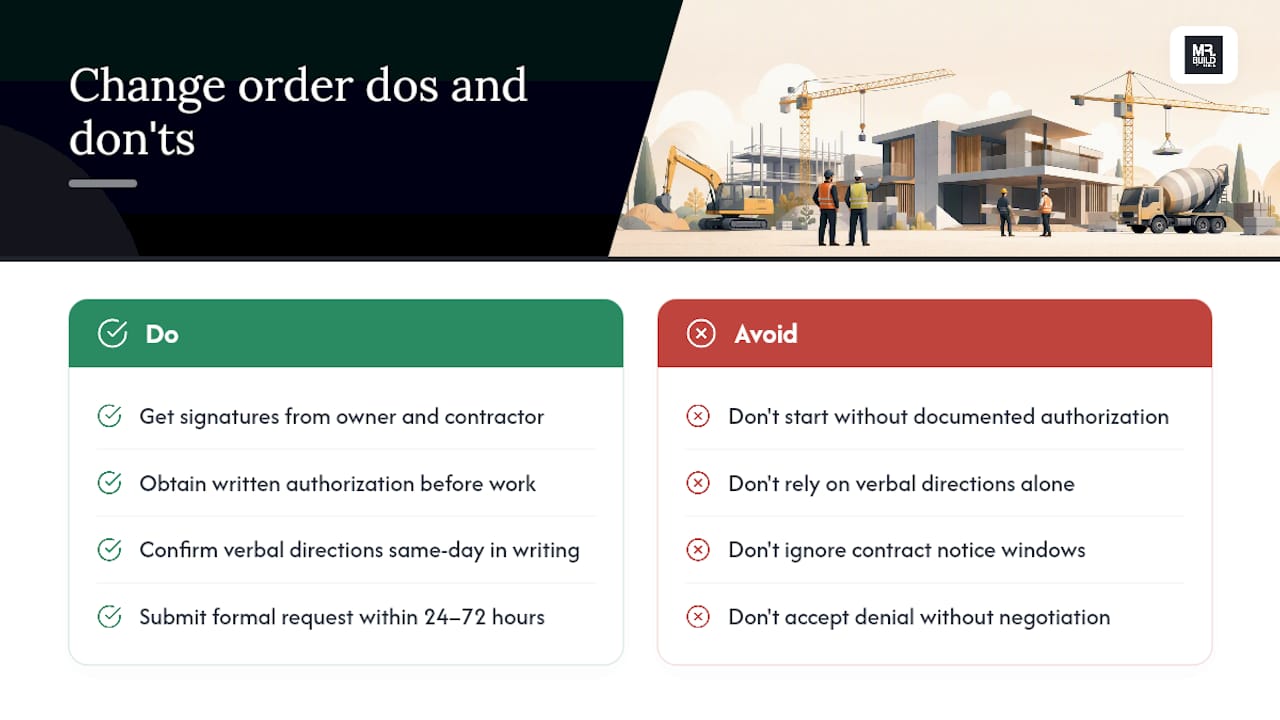
If someone on site gives you a verbal directive to do extra work, do not proceed on faith. Here’s what to do instead:
- Ask for it in writing, even a short email or text confirming scope and cost.
- If the work is urgent and can’t wait, document who gave the direction, when, and what was said, the same day.
- Submit a formal change order request within 24 to 72 hours to protect your right to payment.
Key Takeaways
Managing a construction change order well comes down to one discipline: nothing changes hands, cost, or schedule until it’s written down and signed by both parties.
| Point | Details |
|---|---|
| Get it in writing first | Never start changed work on a verbal directive alone; document and follow up in writing same day. |
| Know your category | Classify the change as an addition, omission, or substitution to route it correctly. |
| Watch notice deadlines | Missing a 7 to 14 day notice window can forfeit entitlement even on valid claims. |
| Prove all three elements | Entitlement, causation, and quantum together determine whether a claim succeeds. |
| Mrbuild’s approach | Mrbuild documents every change with photos, costs, and schedule updates before work proceeds on ADU and remodeling projects. |
Table of Contents
- Understanding Construction Change Orders and Their Categories
- Why Do Change Orders Happen So Often?
- What Is the Construction Change Order Process, Step by Step?
- What Should Every Change Order Document Include?
- How Are Change Orders Priced, and Who Pays?
- How Do You Document Schedule and Productivity Impacts?
- When Do Change Orders Turn Into Disputes?
- Best Practices to Prevent Costly Change Order Problems
- An Editorial Take on the Change Order Playbook
- Building With Fewer Surprises in Los Angeles
- Frequently Asked Questions
- Sources
Understanding Construction Change Orders and Their Categories
A construction change order (sometimes called a variation or modification, depending on the contract form) is the mechanism that legally adjusts what was originally agreed to. It’s not a suggestion or a courtesy update. It’s a contract document, and every one falls into one of three buckets, according to Rhumbix’s breakdown of change order types:
- Addition — new work gets added to the scope, like extending a patio slab that wasn’t in the original plans.
- Omission — work gets removed, such as dropping a planned bathroom because the owner changed the layout.
- Substitution — one material or method replaces another, like swapping quartz countertops for the granite specified in the original bid.
There’s also a distinction worth knowing: owner-directed changes start with a written instruction from the owner or architect, while constructive changes happen when a contractor is effectively forced to do extra work through an action, delay, or omission by the owner, even without a formal directive. AACE International’s guidance on contract change management treats constructive changes as just as real, and just as compensable, as directed ones. Knowing which type you’re dealing with determines who initiates the paperwork and who carries the burden of proof.
Why Do Change Orders Happen So Often?
Design errors, unexpected site conditions, owner-requested upgrades, code updates, and material substitutions are the most common triggers behind a construction change order, and none of them are rare on a real job site.
On major projects, change orders can add up to a notable portion of the total contract value. That’s not a rounding error. It’s a meaningful shift in the budget you signed up for, and Rhumbix’s research also found that 85% of construction projects experience cost overruns, many tied directly to poor change order management rather than the changes themselves.
The good news: most of this risk is preventable.
- A thorough preconstruction review catches design conflicts before they become field problems.
- Site investigations before groundbreaking reduce “surprise” conditions.
- Clear owner communication about scope early on cuts down on late-stage requests.
The projects that manage changes well aren’t the ones that avoid them entirely. They’re the ones that plan for them.
What Is the Construction Change Order Process, Step by Step?
AACE’s recommended practice, RP 100R-19, lays out a structured path from identifying a change to closing it out. Following this sequence protects both sides and keeps the paper trail intact.
- Identify the change in the field. The moment someone notices a discrepancy, whether it’s a site condition or a design conflict, take a photo, log it in the daily report, and note the time and who was present.
- Draft the change order request (COR). Describe the change in plain terms, reference the original drawing or spec section it affects, and attach your evidence: photos, RFIs, and daily logs.
- Submit for review. The owner or architect evaluates the request against the contract’s entitlement language. This is where AACE’s three-part test matters: entitlement (does the contract or circumstance justify a change), causation (can you tie the owner’s action directly to the cost or time impact), and quantum (how much is it actually worth).
- Negotiate. Pricing disagreements are common here. Bring backup documentation, not just a number.
- Approve or deny, then execute. Once both parties sign, the change order becomes part of the contract. Update your master schedule and budget immediately.
Pro Tip: Causation is usually the hardest part of a claim to prove. Keep a running log that ties each disruption directly to a specific owner action or site condition, not just a general note that “things got delayed.”
What Should Every Change Order Document Include?
A change order missing key details is a lawsuit waiting to happen. At minimum, every document needs:
- Project name, date, and contact information for both parties.
- A dated, specific description of the change (not “misc. extra work”).
- Reference to the original contract section or drawing the change modifies.
- A full cost breakdown, not a lump figure with no backup.
- Schedule impact, stated in days, with a revised completion date if applicable.
- Signature lines for both the owner (or owner’s rep) and the contractor.
Attach supporting evidence directly to the document: site photos, relevant RFIs, and daily log excerpts that back up your description. The AIA G701 form is the industry-standard layout for this, and adapting its structure, even if you’re not using the exact AIA template, gives you a format that owners, architects, and courts all recognize.
Pro Tip: A standardized workflow that links RFIs, daily reports, and photos to each proposed change makes a huge difference if the change order gets disputed months later. Memory fades. Documentation doesn’t.

How Are Change Orders Priced, and Who Pays?
Four pricing methods dominate construction change orders, and each carries tradeoffs:
- Lump sum — a fixed price for the change, agreed before work starts. Predictable, but requires accurate upfront estimating.
- Unit price — cost per unit of work (per square foot, per linear foot). Good for quantities that might shift.
- Time and materials (T&M) — billed on actual labor hours and material costs. Flexible, but harder for owners to budget against.
- Not-to-exceed (NTE) — a T&M arrangement with a price ceiling, giving the owner cost protection while keeping some flexibility.
Typical markups run around 10% to 15% for overhead and profit on self-performed work, and 5% to 10% on subcontracted work, though public contracts often cap these percentages and require specific notice timeframes before markup is allowed at all.
Who pays comes down to the same entitlement, causation, and quantum framework from AACE. If you can prove all three, you have a strong position for recovery. If any one is missing, the claim usually stalls.
How Do You Document Schedule and Productivity Impacts?
Time impacts from a change order come in two forms, and confusing them costs contractors money. Direct time is straightforward: the change added five days of work, so the schedule extends five days. Ripple or productivity losses are subtler. A schedule compression from an unrelated change might slow down your crew on other tasks entirely, and that loss needs its own documentation.
To support a time extension claim, gather:
- Daily logs showing actual labor hours and crew size during the affected period.
- A baseline CPM schedule from before the change, compared against an updated version after.
- A time-impact analysis isolating how the change affected critical-path activities specifically.
Research from the Construction Industry Institute confirms that productivity losses from compressed schedules are real and measurable, but only if you’re tracking labor production rates before and after the disruption. Present this analysis to the owner or architect as part of your COR, not as an afterthought filed weeks later.
When Do Change Orders Turn Into Disputes?
Most change order disputes trace back to a handful of predictable triggers: work started without written authorization, notices submitted after the contract’s deadline, pricing left vague or unresolved, and approvals that drag on for weeks.
Missing a contractual notice window, often 7 to 14 days depending on the contract, is one of the most common reasons contractors lose entitlement to a change entirely, even when the underlying work was clearly justified.
If a dispute starts brewing, act fast:
- Preserve every record: emails, RFIs, daily logs, photos, and prior change orders.
- Submit the COR immediately if you haven’t already, even if negotiations feel stalled.
- Loop in the architect or construction manager as a neutral party before positions harden.
- Consider mediation or arbitration if the contract specifies it, before litigation becomes the only option.
Get legal advice the moment a dispute threatens to affect payment on multiple change orders or the project’s completion date. Waiting rarely helps.
Best Practices to Prevent Costly Change Order Problems
- Review the contract’s change order clauses before construction starts, not after a dispute begins.
- Use a standard COR template for every request, no exceptions.
- Track notice deadlines on a shared calendar visible to the whole project team.
- Attach photos and RFIs to every submission, even minor ones.
- Update schedules and budgets the same day a change order is signed.
Pro Tip: The golden rule across every role on the job, owner, GC, or sub, is the same: never start changed work without written authorization. Verbal promises don’t hold up when the invoice comes due.
How Mrbuild Applies Disciplined Change Order Controls
On ADU and addition projects, Mrbuild logs every proposed change with photos, cost breakdowns, and revised schedules before work proceeds.
- Written authorization required before any scope shift begins.
- Updated budgets and timelines shared with homeowners the same week a change is approved.
An Editorial Take on the Change Order Playbook
The conventional advice on change orders treats them like paperwork problems. They’re not. They’re leverage problems. The party with better documentation wins the negotiation, almost regardless of who’s technically right about entitlement. That’s the uncomfortable truth most guides gloss over.
Where the standard advice falls short: it tells contractors to “document everything” without explaining that documentation only has value if it’s tied to a specific causal chain. A daily log full of general notes is nearly worthless in a dispute. A daily log that says “owner’s rep directed removal of load-bearing wall at 10:15 AM, crew idle 45 minutes awaiting revised structural detail” is evidence.
What should the reader prioritize first? Not software, not templates, but the habit of writing things down the same day, every time, without exception. AACE’s framework and AIA’s forms give you the structure. Mrbuild’s field practice on active projects proves that structure only works when someone actually follows it under deadline pressure. That’s the gap between the standard and the outcome.
Building With Fewer Surprises in Los Angeles
Homeowners taking on a custom build, ADU, or full remodel in Los Angeles need a contractor who treats change orders as a planned part of the process, not a source of friction. Mrbuild builds that discipline into every project from the first design meeting: clear documentation, written approvals before any scope shift, and budget updates you see in real time rather than at the final invoice.

If you’re planning a custom home build or an ADU or addition, this is exactly the kind of project where disciplined change management protects your budget and your timeline. Schedule a consultation with Mrbuild to walk through your project scope and see how clear, documented planning keeps your build on track from day one.
Frequently Asked Questions
What is a change order in construction, in simple terms?
It’s a written amendment to your construction contract that changes the scope of work, the price, the completion date, or some combination of the three. It requires signatures from both the owner and contractor to take effect.
Who is responsible for paying for a change order?
It depends on entitlement. If the change stems from an owner request or a design error, the owner typically pays. If it’s due to contractor error or a bid oversight, the contractor often absorbs the cost.
Can a contractor start work before a change order is signed?
Only with clear, documented authorization. Verbal direction should be followed by same-day written confirmation and a formal request submitted within 24 to 72 hours to protect payment rights.
How long does change order approval typically take?
It varies by contract, but many require a response within the notice window specified in the agreement, often 7 to 14 days. Delays beyond that window can affect contractor cash flow significantly, as GAO’s federal review found.
What happens if a change order request is denied?
The contractor can negotiate further, escalate to mediation or arbitration if the contract allows it, or pursue a formal claim if the denial appears to conflict with contract terms.
Sources
AACE RP 100R-19, AIA G701 form, GAO federal report, and AGC guidance.
- 100R-19: Contract Change Management – As Applied in Engineering, Procurement, and Construction — AACE International
- What is a change order in construction? — Rhumbix
- Change order management: A step-by-step guide for contractors — AECify

